

CAPLA Open House Invites Tucson Community to Help Envision the Future of the Santa Cruz River
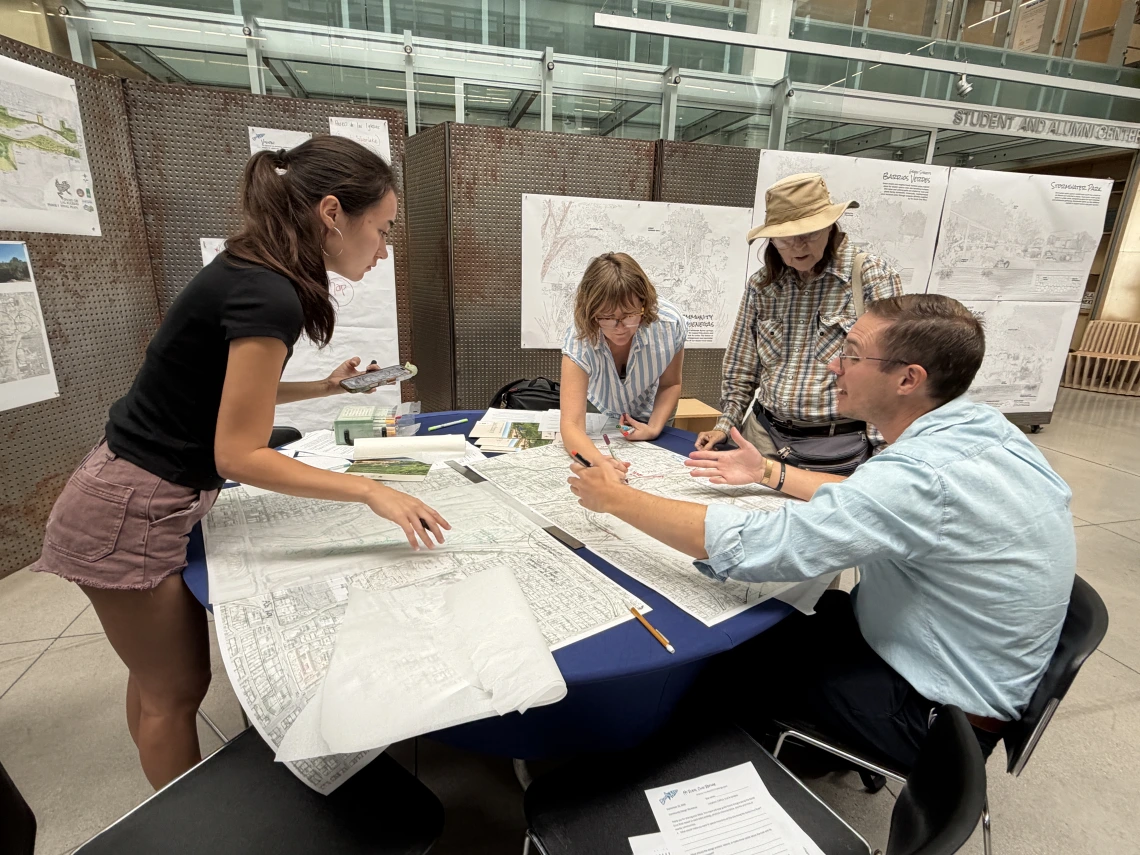

Students, professionals and community members gathered at CAPLA for an open house focused on the future of the Santa Cruz River corridor in September.
The event was part of the Tucson Urban Wildlife Refuge Vision Framework, a project supported by a National Fish and Wildlife Foundation America the Beautiful Challenge Planning Grant. The planning effort is focused on a portion of the Santa Cruz River corridor stretching from Irvington Road to Camino Del Cerro and is designed to explore community priorities, stewardship opportunities and potential designs for selected sites along the river.
Rather than presenting a finished plan, the open house gave participants an opportunity to share their ideas, preferences and knowledge about the river and surrounding areas. The information gathered through the project will contribute to a broader framework that can support future local projects, partnerships and stewardship efforts, as well as potentially inform the proposed Santa Cruz River National Wildlife Refuge.
“This is a community workshop and an open house. It’s a listening session where we are inviting all kinds of experts,” said Mackenzie Waller, assistant professor in landscape architecture.
The planning grant runs from 2025 to 2027 and supports community engagement, ecological assessment and site visioning along the river corridor. The project is exploring what communities value about the river and its surrounding sites, as well as how spaces might accommodate both human and wildlife needs.
CAPLA students are playing a central role in documenting and analyzing six sites along the Santa Cruz River. Their role at the event was to listen, record community feedback and gather additional information that can help shape the project’s ongoing work.
“These sites have a lot of positive energy around them and these students are in charge of collecting and creating base maps and documentation, site analysis, and some target design species research,” Waller said.
For students, the project provides an opportunity to work on a real-world planning and landscape architecture effort while engaging directly with members of the public and professionals working in the field.

Alex Stoicof, CAPLA alumni and landscape architect with McGann & Associates, served as a real-world anchor for the open house.
“I’ve worked on a lot of projects in the city and along the Santa Cruz, so Mackenzie thought I would be a good fit to help facilitate some of the conversations and support the students,” Stoicof said.
Stoicof said the event gave students the chance to strengthen an important professional skill: communicating with people outside the classroom and creating an environment where community members feel comfortable participating.
Nichole Casebeer, a landscape architect with the Pima County Regional Flood Control District, attended to represent the district and hear from community members about sites owned and managed by the county.
Casebeer emphasized the importance of the involvement by CAPLA students in the open house.

“We’ve been collaborating with the students to put together the materials and activities for the site today, so they can support relationship building with community members,” Casebeer said. “They’ve been developing really creative ways to engage the community about wildlife, ecology and the different kinds of non-human elements represented at these sites.”
The sites being discussed represent environmental resources within the city, and the open house provided an opportunity for community members to learn more about them while contributing their own perspectives.
“The goal today is to get people curious and excited, and aware of these really beautiful gems that we have around the city in terms of environmental property,” Casebeer said. “Any amount of awareness we can build is important and special.”
The project’s focus extends beyond potential future designs. The planning grant is also intended to document the river’s ecology and history and to better understand community priorities along the corridor.
“The Santa Cruz River is the reason that Tucson is here, and it has been stewarded since time immemorial,” Waller said. “We have a lot of really great experts in indigenous communities that can show us the way. We are trying to learn from them and figure out how to carry on this tradition.”
That emphasis on existing knowledge and stewardship is also reflected in the project’s broader purpose.
“What’s most important is for people to understand that this is a river city, and this project is nothing new,” Waller said. “This is something that is following the guidance of indigenous leaders and community efforts. Our work here is to create documentation, not to try to brand it as anything new or novel.”
The overall project is a planning effort, meaning the grant does not fund on-the-ground implementation or construction. Instead, the team will produce information, documentation and outreach resources that can help communities and potential partners decide whether and how they want to pursue future initiatives.
Waller said creating opportunities for people to participate directly is an important part of building the relationships needed for long-term stewardship.
“If we make this a project by and for the community, then it has the potential to succeed long-term,” Waller said.

The project team includes experts from the University of Arizona, Pima County Regional Flood Control District, Sonoran Institute, The Wilderness Society, Tierra y Alma, and Tucson Bird Alliance.
For more information on the project, visit santacruzrefuge.org.


