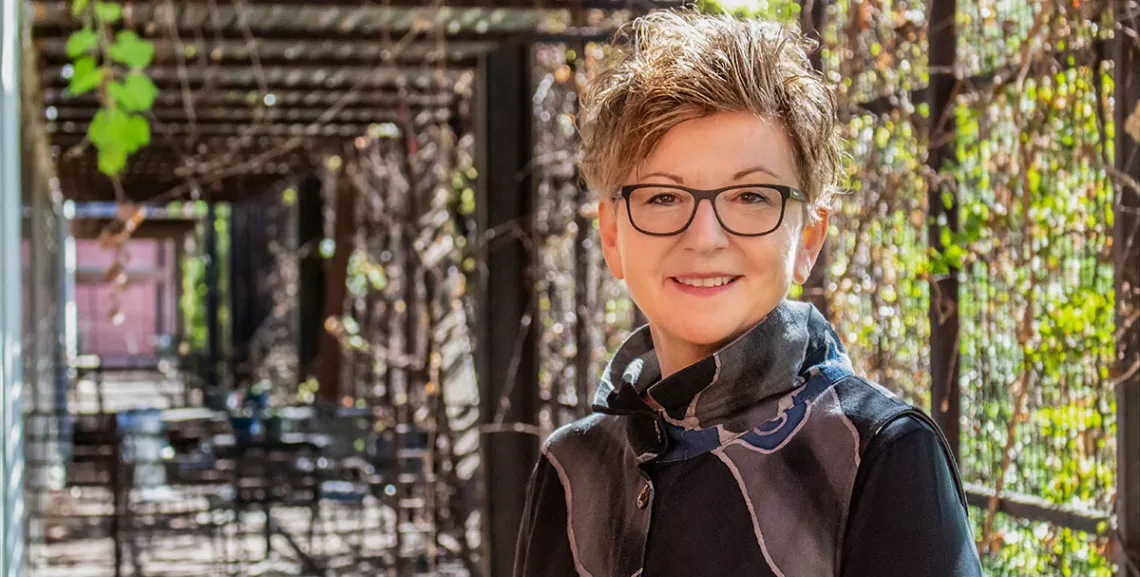
Walking, Cycling, Leading: Meet CAPLA Dean Nancy Pollock-Ellwand

Sept. 30, 2020
Who
Nancy Pollock-Ellwand, Dean and Professor of Landscape Architecture
What
Interview
Image
Nancy Pollock-Ellwand

In September 2020 College of Architecture, Planning and Landscape Architecture Dean Nancy Pollock-Ellwand, who joined CAPLA in 2017, was interviewed for the UArizona news site Lo Que Pasa. Read the interview on the CAPLA website.

The interview begins:

Why did you choose to join the University of Arizona?

This is a great opportunity to lead a remarkable college of faculty, staff and students dedicated to innovation in the built environment, situated within a powerful multidisciplinary setting in a part of the world that is highly distinctive climatically, environmentally, culturally and socially. I also feel well-supported here in trying new ideas, allowing me to exert my own creativity in the role of an academic administrator.
 

Read the Full Interview


Subscribe to The Studio

Sign up for CAPLA's monthly e-newsletter to get the latest news and events, insights from faculty and leadership, profiles of students and alumni and more.

Subscribe Now

Latest CAPLA News, Projects and Profiles

Image
Ryan Smith

Ryan Smith co-authors HUD report advancing offsite construction for U.S. housing

Ryan Smith, director of the University of Arizona’s School of Architecture, co-authored a U.S. Department of Housing and Urban Development (HUD) report outlining a national strategy to expand offsite construction as a solution to housing affordability and supply challenges. Drawing on global case studies, the report introduces an Offsite Action Plan focused on regulatory reform, innovation and education to accelerate scalable, high-quality housing production.

Image
Lauren Bon

Lecture Recap | The Cyborg Watershed of the American West | A Jones Studio Grand Challenges Lecture featuring Lauren Bon

An engineered network of waterways flowing west from the Rockies sustains life in one of the hottest regions on Earth, forming a “cyborg watershed” that blends natural systems with human-made infrastructure and regional mythologies. Bon explored this system through her large-scale artworks, examining buried waterways, the complexities of policy and politics, and the pursuit of a civic identity shaped by water rather than boundaries.