

CAPLA Planning and Real Estate Law Professor Helps Land Tucson Midtown Townhomes on National Register of Historic Places
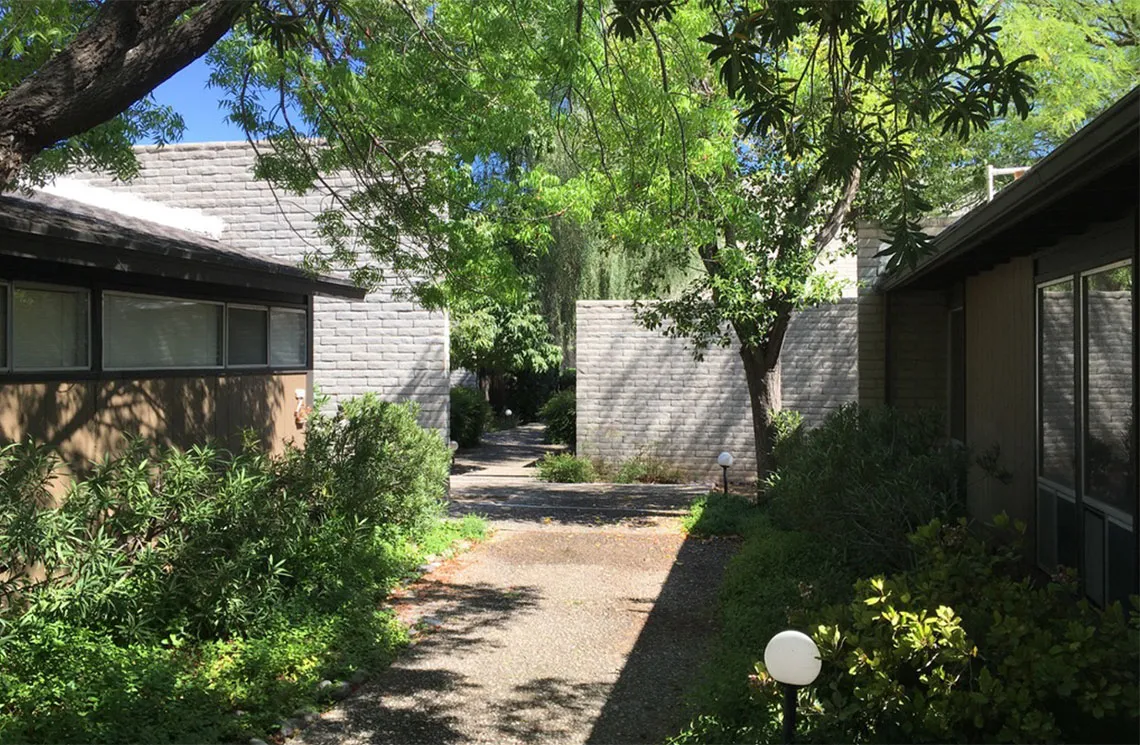
A courtyard entryway at Orchard River Garden Park. Photo courtesy Linus Kafka.
“Historic districts really preserve value in real estate, honor history and create community,” says Linus Kafka, professor of practice in planning and real estate law at the University of Arizona’s College of Architecture, Planning and Landscape Architecture.
Kafka, who also serves as the assistant director of the BA and MLS in Law programs at the James E. Rogers College of Law, has first-hand experience—beginning in 2019, he worked with fellow neighbors to add the 50-year-old Orchard River Garden Park in Tucson to the National Register of Historic Places. The “desert modernist” development of 136 units built on a former pecan orchard and designed by architect Robert Swaim was added to the list by the National Park Service this year.

Linus Kafka, Professor of Practice in Planning and Real Estate Law
Kafka was featured in a Tucson Sentinel article published on March 4, 2022, that discusses the unique community and its placement on the National Register—Pima County’s first addition since 2009.
“It’s not historicist architecture. It’s modern architecture, but it's a really sensitive form of modern architecture that knows its space and environment,” Kafka says in the article. “Some modern architecture ignores the environment and celebrates itself…. [Orchard River] really echoes its history and surroundings without being slavish or historicist.”
Kafka does not expect housing prices in the townhome complex to rise due to its new designation. Rather, “[w]hat the historic nomination does is generate interest and acknowledgment,” he says in the article. “[P]eople who didn’t know about it will start to see it and that’s a good thing because it’s recognizing that we have really distinctive, wonderful architecture here in Tucson.”
Kafka, who joined CAPLA in 2016, teaches urban planning law and real estate development law. As an attorney, he specialized in land use law and local government law. He holds a JD from the University of Arizona, an MA from New York University and a PhD in history from UCLA, with a focus on American intellectual and urban history. His research focused on the influence elite world travelers have had on American arts and culture during the late 19th and early 20th centuries, with particular attention to developments in physical space and the built environment. In addition to UArizona, Kafka has taught history and law at UCLA, University of California Irvine and Eastern Kentucky University.


