El Camino Verde: Emily Lorenz, Heather Schmidt, Irene Pineda, Austin Young and Jordan Lawson MLA

July 1, 2020
Who
Emily Lorenz, Heather Schmidt, Irene Pineda, Austin Young, and Jordan Lawson
What
Student Work | MLA Studio Project, Taught by Bo Yang, Professor of Landscape Architecture
Where
Tucson, Arizona
When
2020
Image
El Camino Verde, by MLA students

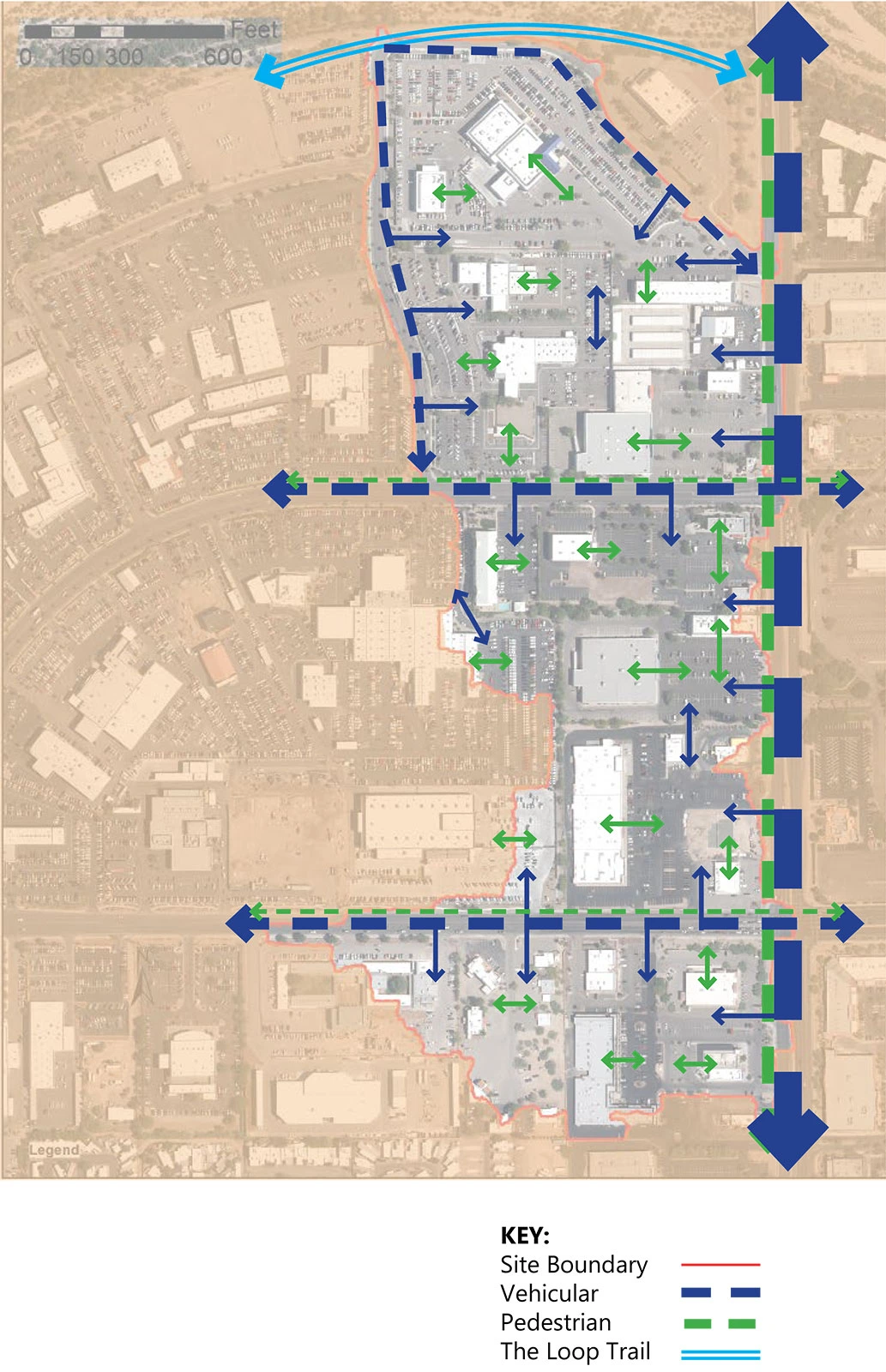
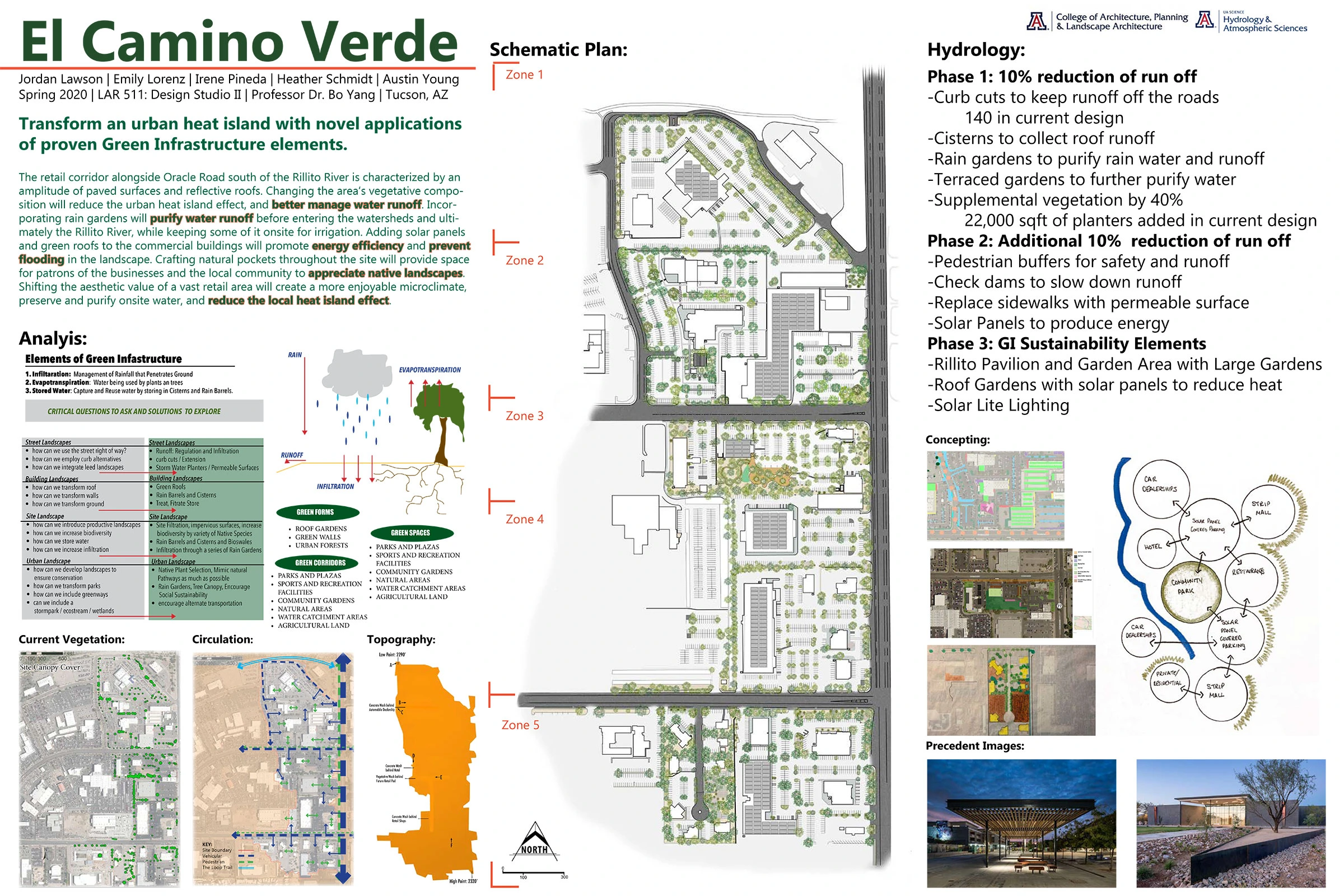
El Camino Verde is a project addressing the hottest land plot in Tucson. It is so hot because the majority of the site is covered in impermeable surfacing, mostly asphalt and concrete. This causes serious runoff problems in the area including flooding and contaminating the Rillito River, located just north of the site. This site is massive, so Master of Landscape Architecture students Emily Lorenz, Heather Schmidt, Irene Pineda, Austin Young, and Jordan Lawson wanted to include options for the future, based on financial restrictions.

First, they divided the site into five zones, assigning each zone to a team member. In each zone, the student team implemented as many green infrastructure designs and elements as possible. The goal was to reduce runoff and keep water onsite and therefore increase tree canopy and decrease the urban heat island effect.

The first phase was the simplest and least costly and will reduce runoff by 10 percent. The design elements include curb cuts into green areas from the parking lots and streets, adding cisterns to collect roof runoff and water green areas during drought and adding more vegetative areas and terraced rain gardens to collect and purify water.

The second phase will reduce runoff by an additional 10 percent but is more expensive. These elements are creating pedestrian buffers between major roads and sidewalks to increase sense of safety and add more vegetation and create a place for the street runoff to go, building check dams to slow down runoff, replacing sidewalks with permeable surfacing, and adding solar panels to the roofs to produce energy as well as create shade for potential roof gardens.


Image Gallery

Click a thumbnail below to view a larger image and begin slideshow:


All images are by Emily Lorenz, Heather Schmidt, Irene Pineda, Austin Young, and Jordan Lawson and may not be used or reproduced without express written permission of their creators.

Latest CAPLA News, Projects and Profiles

Image
Group photo of four CAPLA students who are members of the ISAPD

CAPLA to host Indigenous Design Symposium focused on community, sustainability

CAPLA’s Indigenous Society of Architecture, Planning and Design (ISAPD) will host an all-day symposium on April 6, bringing together students, faculty and practitioners to explore Indigenous approaches to the built environment. Featuring Indigenous designers and supported by campus partners, the event will highlight community-centered design, sustainability and the role of Indigenous knowledge systems in shaping more responsible relationships with land.

Image
Six students and faculty work together to lift the frame of a wall for a house they are building in Agua Prieta

CAPLA students build housing in Agua Prieta during spring break

CAPLA students spent spring break in Agua Prieta, Sonora, building a home for a local family in partnership with Rancho Feliz. Working alongside community members, they gained hands-on construction experience while contributing to a reciprocal housing program designed to address affordability and climate-responsive design.

Image
Jackie Hogan Headshot

Research-Based Approach to Architecture: Jackie Hogan M.Arch + MS.Arch ‘25

Jackie Hogan (’25 M.Arch + MS.Arch) is a dual-degree graduate of CAPLA whose work bridges architectural practice and research-driven design. Drawn to architectural history, theory and ethics, she pursued the M.Arch + MS.Arch dual degree to explore how research can shape meaningful design decisions. During her time at CAPLA, she engaged in community-centered design through Laura Carr’s studio working with the Tuba City community and completed a thesis examining architecture’s role in disaster relief and climate-related emergencies. Now working at Line + Space, Hogan brings an evidence-based approach to projects, applying research to create thoughtful spaces that connect people, culture and the environment.