

Civil Engineering Magazine Discusses Green Infrastructure Proposals Created by CAPLA Architecture Students
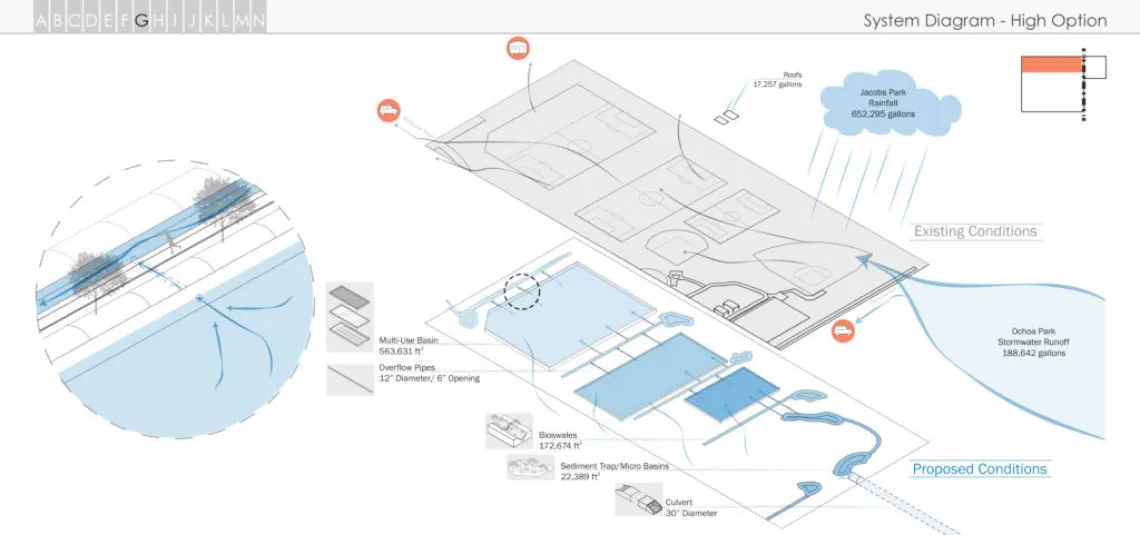
A proposal from an architecture studio led by Assistant Professor of Architecture Courtney Crosson calls for lowering a soccer field in northwest Tucson as a temporary stormwater detention basin. Image courtesy Jeremy Goodman and Jason Sciarrotta.
“How do you retrofit a city for infrastructure that it doesn’t have?” asks Assistant Professor of Architecture Courtney Crosson in a June 10, 2021 article in Civil Engineering magazine. “The idea is that instead of digging up roads and putting in single-purpose piping, green infrastructure is a multi-benefit way to adapt and upgrade city infrastructure.”
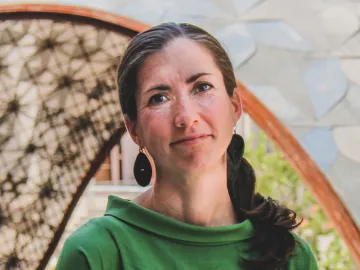
Assistant Professor of Architecture Courtney Crosson.
The article, “Arizona city pilots small green infrastructure projects,” addresses a growing problem for Tucson: stormwater flooding. For example, a substantial monsoon rainstorm in 2016 damaged 200 homes in the Palo Verde Neighborhood of central Tucson.
The solution: decentralized stormwater management, and students in Crosson’s architecture studio course created a series of proposals for the City of Tucson and Pima County to implement localized stormwater drainage solutions.
In one project cited in the article, Crosson and her students worked with the Pima County Flood Control District to “explore how a large soccer field at Jacobs Park-Nicolas P. Ochoa Soccer Complex on the city’s north side could be redesigned to serve as a temporary detention basin,” reports the article.
“Instead of building a big canal, what if we took our soccer fields and lowered them a foot or two so that right after monsoons, they’re acting as detentions for a day or two?” says Crosson. “But then after that, they can be used again. Because we’re only getting these isolated storms, this idea of multipurpose green infrastructure makes sense.”
The article concludes with a review of local funding available for green infrastructure projects such as this, noting that “there is evidence that these small-scale interventions can help.”


