
Feature on Tucson Urban Food Forest in the Guardian Quotes Sustainable Built Environments Professor Ladd Keith
April 12, 2023
Who
Ladd Keith, Assistant Professor of Planning and Sustainable Built Environments
What
Quoted in The Guardian
Image
Urban forestry work

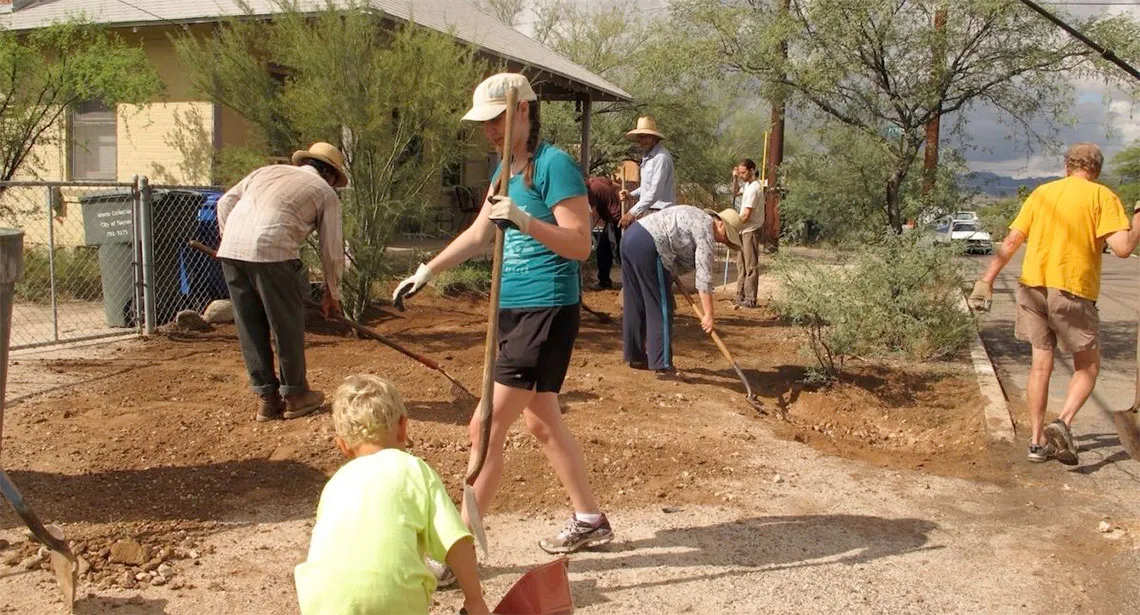
Urban forestry work by neighbors in Tucson's Dunbar/Spring neighborhood. Photo courtesy Dunbar/Spring Neighborhood Foresters.

A March 21, 2023 feature on Tucson’s Dunbar/Spring neighborhood in The Guardian, “‘A living pantry’: how an urban food forest in Arizona became a model for climate action,” quotes CAPLA Assistant Professor of Planning and Sustainable Built Environments Ladd Keith.
Image
Ladd Keith, Associate Professor of Planning and Sustainable Built Environments

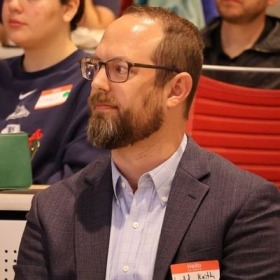
Ladd Keith, Associate Professor of Planning and Sustainable Built Environments.

“If climate change continues at its current pace, cities in the Southwest such as Tucson could experience as much as 45 days more per year with temperatures above 90F [32C] by 2100,” says Keith in the article.

Keith’s quote follows from a truth about the inequitable effects of extreme heat: “Heat is felt by all, but not equally,” says the article. “In Tucson and across the U.S., low-income areas are disproportionately warmer than affluent ones, putting those residents at higher risk of heat-related illnesses.”

The Dunbar/Spring neighborhood, near downtown Tucson, is a lower-income area—but residents, through programs such as Dunbar/Spring Neighborhood Foresters urban forestry initiative—are working hard to offset rising heat in their neighborhood and Tucson more broadly.

Read the full article in The Guardian.

Keith, who joined CAPLA in 2009, has over a decade of experience planning for climate change with diverse stakeholders in cities across the U.S. His research explores heat planning and governance with funding from the National Oceanic and Atmospheric Administration, the Centers for Disease Control and Prevention, and the Department of Transportation. He is also a faculty research associate at the Udall Center for Studies in Public Policy. In addition to founding CAPLA’s Bachelor of Science in Sustainable Built Environments, Keith teaches public participation and dispute resolution as well as climate action planning.


Subscribe to The Studio

Sign up for CAPLA's monthly e-newsletter to get the latest news and events, insights from faculty and leadership, profiles of students and alumni and more.

Subscribe Now

Latest CAPLA News, Projects and Profiles

Image
Group photo of four CAPLA students who are members of the ISAPD

CAPLA to host Indigenous Design Symposium focused on community, sustainability

CAPLA’s Indigenous Society of Architecture, Planning and Design (ISAPD) will host an all-day symposium on April 6, bringing together students, faculty and practitioners to explore Indigenous approaches to the built environment. Featuring Indigenous designers and supported by campus partners, the event will highlight community-centered design, sustainability and the role of Indigenous knowledge systems in shaping more responsible relationships with land.

Image
Six students and faculty work together to lift the frame of a wall for a house they are building in Agua Prieta

CAPLA students build housing in Agua Prieta during spring break

CAPLA students spent spring break in Agua Prieta, Sonora, building a home for a local family in partnership with Rancho Feliz. Working alongside community members, they gained hands-on construction experience while contributing to a reciprocal housing program designed to address affordability and climate-responsive design.

Image
Jackie Hogan Headshot

Research-Based Approach to Architecture: Jackie Hogan M.Arch + MS.Arch ‘25

Jackie Hogan (’25 M.Arch + MS.Arch) is a dual-degree graduate of CAPLA whose work bridges architectural practice and research-driven design. Drawn to architectural history, theory and ethics, she pursued the M.Arch + MS.Arch dual degree to explore how research can shape meaningful design decisions. During her time at CAPLA, she engaged in community-centered design through Laura Carr’s studio working with the Tuba City community and completed a thesis examining architecture’s role in disaster relief and climate-related emergencies. Now working at Line + Space, Hogan brings an evidence-based approach to projects, applying research to create thoughtful spaces that connect people, culture and the environment.