City of Tucson's Climate Action and Adaptation Plan

April 18, 2022

Social Equity, Environmental Resilience + Identity and Community
Overview
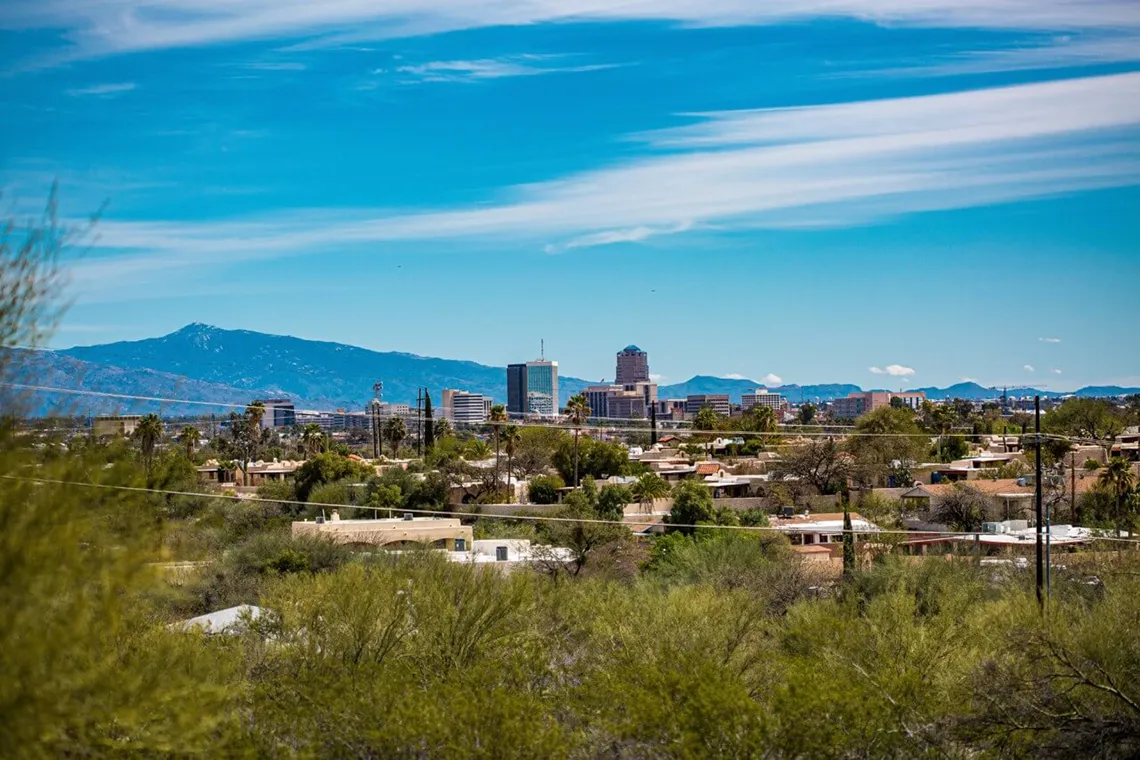
Faculty members Courtney Crosson and Ladd Keith, along with community partners, develop a Climate Action and Adaptation Plan (CAAP) to help the City of Tucson establish a path to reduce carbon emissions and adapt to the impacts of climate change.
Who
Ladd Ketih, Assistant Professor of Planning and Sustainable Built Environments and Courtney Crosson, Assistant Professor of Architecture
Where
Tucson, AZ
When
January 2022- December 2022
Image

Project Overview

The Climate Action and Adaptation Plan (CAAP) is an essential next step in helping the City of Tucson establish an aspirational yet achievable path to further reducing carbon emissions and adapting to the impacts of climate change. The CAAP will also align with the efforts of cities across Arizona and around the country to coordinate and promote climate adaptation and community resiliency strategies at the local and regional levels. The Drachman Institute was hired by the City of Tucson as part of the consultant team to complete the plan led by BuroHappold Engineering and including Living Streets Alliance and AutoCase. Courtney Crosson serves as visioning lead and Ladd Keith serves as planning lead for the CAAP.


Community Partners and Consultants

  • Living Streets Alliance
  • BuroHappold Engineering
  • AutoCase Economic Consultant

Gallery
Latest CAPLA News, Projects and Profiles

Image
Ryan Smith

Ryan Smith co-authors HUD report advancing offsite construction for U.S. housing

Ryan Smith, director of the University of Arizona’s School of Architecture, co-authored a U.S. Department of Housing and Urban Development (HUD) report outlining a national strategy to expand offsite construction as a solution to housing affordability and supply challenges. Drawing on global case studies, the report introduces an Offsite Action Plan focused on regulatory reform, innovation and education to accelerate scalable, high-quality housing production.

Image
Lauren Bon

Lecture Recap | The Cyborg Watershed of the American West | A Jones Studio Grand Challenges Lecture featuring Lauren Bon

An engineered network of waterways flowing west from the Rockies sustains life in one of the hottest regions on Earth, forming a “cyborg watershed” that blends natural systems with human-made infrastructure and regional mythologies. Bon explored this system through her large-scale artworks, examining buried waterways, the complexities of policy and politics, and the pursuit of a civic identity shaped by water rather than boundaries.