
Modern Workspace Campus: Lynn Capouya '79 BLA, Lynn Capouya Inc. Landscape Architects
Nov. 12, 2020
Who
Lynn Capouya '79 BLA, Lynn Capouya, Inc. Landscape Architects
What
Alumni Work | AMP&RSAND Modern Workspace Campus
Where
San Diego, California
When
2019
Image
AMP&RSAND Modern Workspace Campus

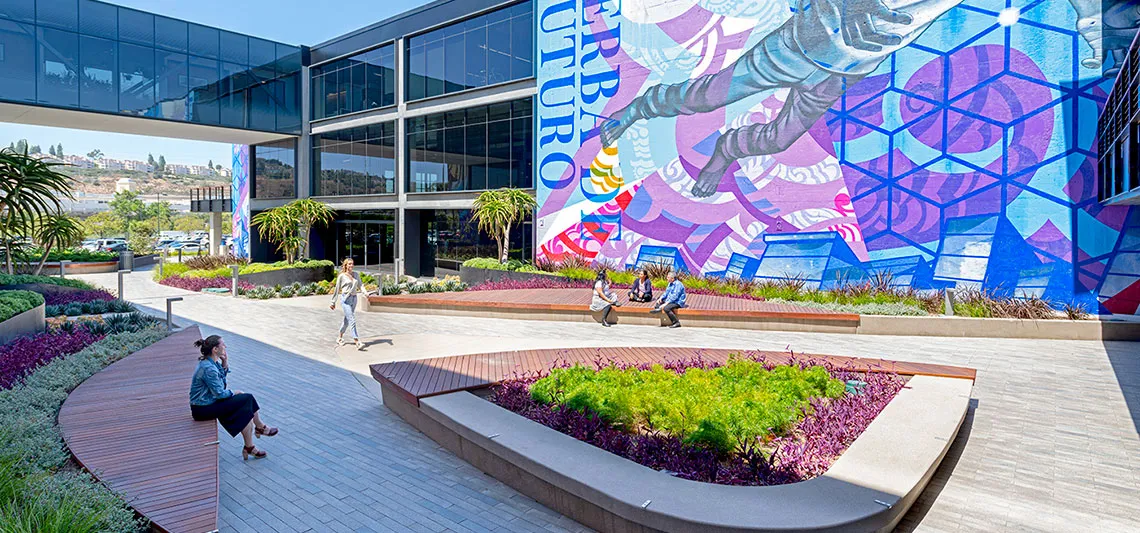
This unique project, located in San Diego, is a re-imaging of the iconic San Diego Union-Tribune newspaper offices and printing press into a 330,000 square-foot creative office complex. Collaborating with the project architect, LCI developed a story for the site design that connects the client’s vision with the Union-Tribune’s rich history, San Diego River, trolley and trail system. The landscape area encompasses over 3.5 acres of outdoor spaces and planting within an overall site area of 14 acres.

LCI themed the central courtyard, entitled the Riverlands, as an abstract connection to the adjacent San Diego River and local outdoor culture. It has an organic "river-like" flow which stretches from south to north and winds through the parking spine with a connection planned for a future river trail phase.  The Press Building courtyard was previously where the U-T printing press machine operated and has been aptly themed after this use. Entitled Press City, this courtyard has an urban industrial character with a modern flow, abstracting the news stories rolling off the printing spools and into the community.

A variety of outdoor spaces provide tenants with opportunities for working, socializing, gaming, relaxing and reflecting. The plant palette is a mix of drought-tolerant, California-friendly materials: grasses mixed with agaves, accent trees and colorful sensory plantings. Portions of the landscape provide a mix of culinary plantings and fruit trees to complement a future craft café and/or restaurant.

Awards and Exposure

  • ENR California Magazine Best Project Award, Renovation/Restoration Category, 2019
  • Feature story in Landscape Architect and Specifier News, January 2020

Image Gallery

Click a thumbnail below to view a larger image and begin slideshow:


All photographs are by Jasper Sanidad and may not be used or reproduced without express written permission of their creator.

Latest CAPLA News, Projects and Profiles

Image
View of the Colorado river from the bottom of the Grand Canyon: two small rafts can be seen on the water in the distance and high cliffs rise in the background

Reimagining the Colorado River in the context of Water Management in Arizona | Lecture by Kathy Jacobs

The Colorado River is the backbone of water management in the southwest, serving seven states and Mexico. Ongoing drought conditions that are linked to climate change threaten Colorado River water deliveries to Arizona, but also provide an opportunity to rethink the allocation of water rights and to focus on a more sustainable approach to management.

Image
Teresa Rosano AIA awards

Teresa Rosano Receives Dual Honors at the 2025 AIA Arizona Design Awards

In November, Associate Professor Teresa Rosano received two top honors at the 2025 AIA Arizona Design Awards: the Architects Medal and a Community Design Award for a student-led capstone project. The recognized project—the Tucson Hope Factory Micro Shelter Village—aims to support unhoused communities in Southern Arizona through a collaborative, student-designed micro-shelter prototype. Rosano’s awards highlight both her influential architectural career and her deep commitment to education, adding to her recent series of teaching achievements.

Image
Tucson, Arizona

Balancing Buyer Protections with Development Costs: A Panel Discussion on Arizona’s Construction Defect Liability Law

In this panel discussion, we will explore the impact of Arizona’s construction defect liability laws on multifamily development, with a particular focus on possible legislative reforms to better balance buyer protections with development costs. While construction defect liability laws provide important protections for buyers, there is a growing concern among researchers and housing advocates that, if overly restrictive, these laws can increase development costs and lower production.