

CAPLA-Led UArizona Team Takes Second Place in EPA’s Eighth Annual Campus RainWorks Challenge
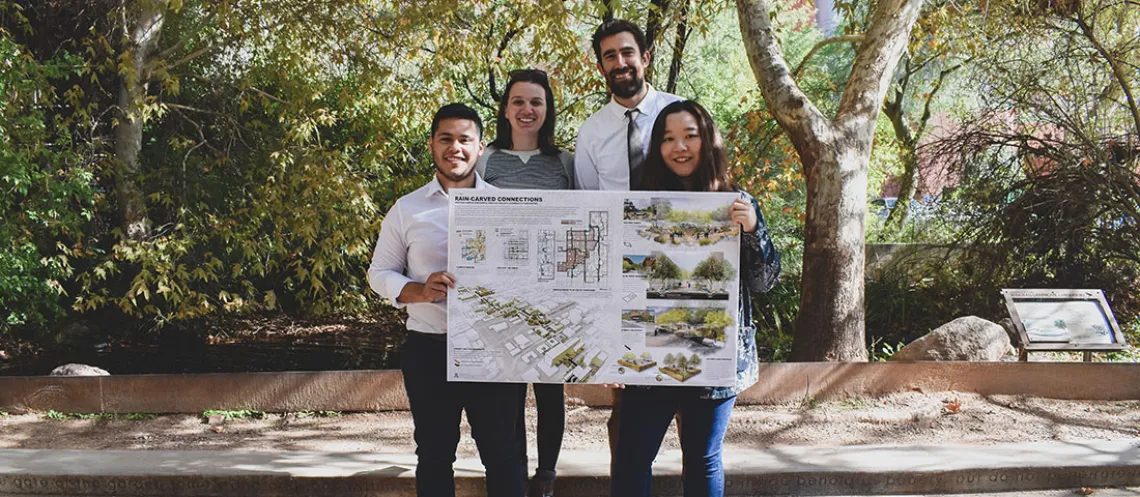
CAPLA's winning team: Isaac Palamo, Tess Wagner, Mario Nuño-Whelan and Jinqiao Deng.
The U.S. Environmental Protection Agency has recognized the University of Arizona as second-place winner in the Master Plan category of its eighth annual Campus RainWorks Challenge, a national competition that engages college students in the design of on-campus green infrastructure solutions to help address stormwater pollution.
UArizona’s “Against the Grain” project integrates multiple green infrastructure practices into a master plan design that revitalizes key transportation and pedestrian corridors on the university’s main campus in Tucson. The project seeks to enhance flood protection through inclusion of bioretention facilities with native plants and trees, and treat stormwater runoff as a resource by incorporating cisterns for irrigation.
The student team is comprised of four Master of Landscape Architecture students from the College of Architecture, Planning and Landscape Architecture—Jinqiao Deng, Isaac Palomo, Mario Nuño-Whelan and Tess Wagner—as well as UArizona students Hannah Talkington (BS in Biology), Joyce Chen Wang (BS in Computer Science in Mathematics), Jesus Mulgado (MS in Biosystems Engineering), Jesus De Los Reyes (BS in Environmental and Water Resource Economics) and Peter Price (Graduate College).
The faculty advising team is led by CAPLA Associate Professor of Landscape Architecture Bo Yang, and also includes Grant McCormick, adjunct professor of environmental science and campus planner, Tanya Quist, associate professor of plant sciences, Vanessa Buzzard, senior research specialist at the School of Natural Resources and the Environment and Laura Meredith, assistant professor, School of Natural Resources and the Environment.
“We are proud of the achievements of our faculty and talented students who won the prestigious EPA RainWorks Challenge for the third year in a row,” says Nancy Pollock-Ellwand, CAPLA dean. “Their project demonstrates the need for a certain kind of scholar and designer who considers things critically, and imaginatively. The integrated stormwater solutions these students have developed speak to the realities of a desert landscape where rains come infrequently, but with incredible force.”
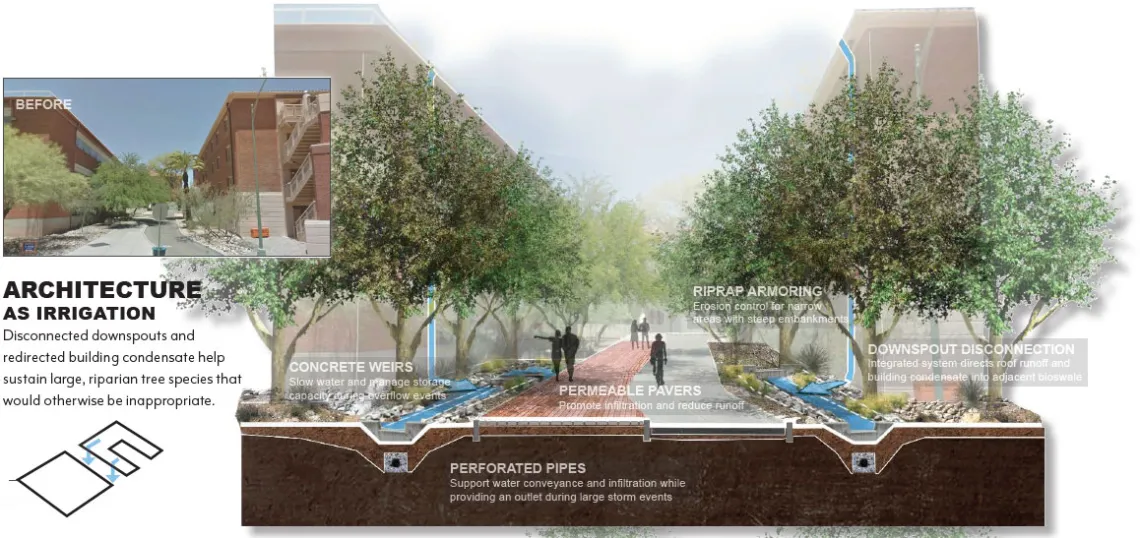
From Against the Grain: Carving Campus Corridors Through Stormwater Diversion and Capture
EPA’s Campus RainWorks Challenge asks students and faculty members at colleges and universities across the country to apply green infrastructure design principles, foster interdisciplinary collaboration and increase the use of green infrastructure on the nation’s college campuses. Since 2012 more than 700 teams have participated in the challenge.
This year EPA invited student teams to compete in two design categories. The Master Plan category examines how green infrastructure can be broadly integrated across campus while the Demonstration Project category focuses on how green infrastructure can address stormwater pollution at a specific site on campus. With the help of a faculty advisor, teams of students focus their expertise, creativity and energy on the challenges of stormwater management and showcase the environmental, economic and social benefits of green infrastructure.
“Stormwater runoff is a significant source of water pollution in America, and managing runoff remains a complex environmental challenge for local communities across the Pacific Southwest,” says EPA Pacific Southwest Regional Administrator John Busterud. “This year’s winners have skillfully transformed classroom knowledge into innovative and replicable solutions for stormwater management in Arizona.”
The UArizona team receives a $2,500 student prize and a $2,500 faculty prize. A team from Florida International University won first place in the Master Plan category, while teams from the University of California, Los Angeles and Arizona State University won first and second place in the Demonstration Project category, respectively.
View the "Against the Grain" design board created by the UArizona team. And learn more about CAPLA’s award-winning Master of Landscape Architecture program at capla.arizona.edu/mla.


