

Prize-winning E-ROBOT Technology Created by UArizona Architecture and Engineering Professors Showcased on Local CBS Affiliate
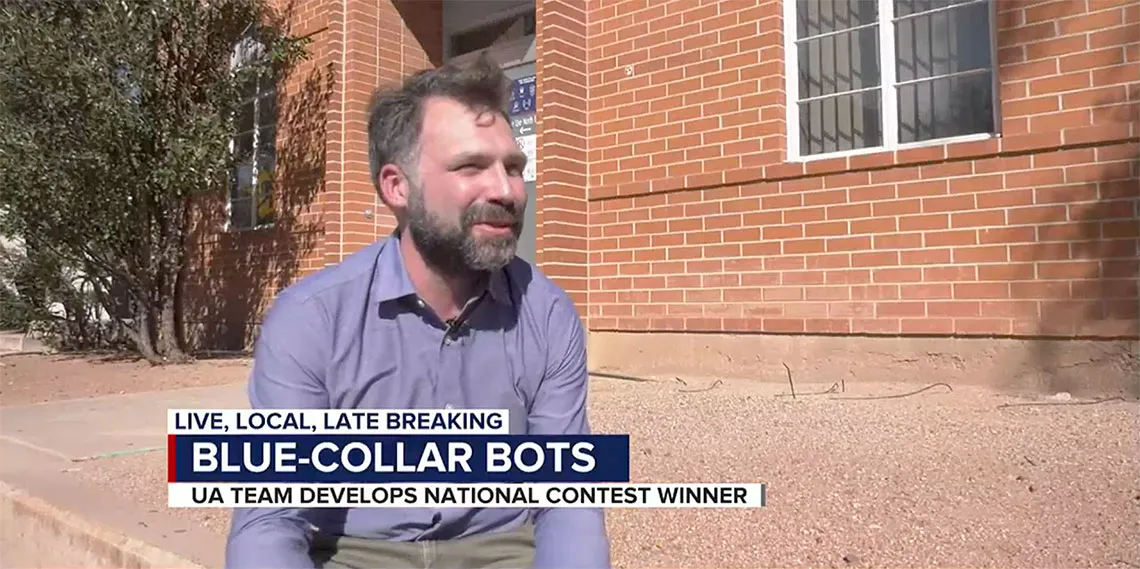
Assistant Professor of Architecture and Sustainable Built Environments Jonathan Bean discusses wall-EIFS on KOLD News 13, Tucson's CBS affiliate.
University of Arizona Assistant Professor of Architecture and Sustainable Built Environments Jonathan Bean and Associate Professor of Electrical and Computer Engineering Wolfgang Fink were featured in a November 1, 2021 news segment by Tucson, Arizona CBS affiliate KOLD News 13: “UA professors win prize for robotic technology that addresses climate change, labor shortage.”
Bean and Fink won one of ten 2021 U.S. Department of Energy E-ROBOT (Energy Envelope Retrofit Opportunities for Building Optimization Technologies) Prizes of $200,000 for wall-EIFS, their robotically applied, 3D-sprayable exterior insulation and finish system for building envelope retrofits.
The KOLD News 13 story focuses on how the duo’s project can help reduce carbon emissions while addressing labor shortages for building exterior insulation retrofits, noting that existing buildings account for a larger portion of carbon emissions globally.
Bean and Fink’s system replaces the intensely manual process of retrofitting by using a robot to spray insulation.
“We like this idea of taking the existing labor force and helping more people actually get higher-value work and also expanding the number of buildings we can retrofit and add insulation too,” Bean says in the story.
View the video on KOLD News 13.
Bean, who joined the College of Architecture, Planning and Landscape Architecture in 2017, is a PHIUS Certified Passive House Consultant and serves on the board of the Passive House Alliance U.S. He also serves as scholarship chair for the Society of Building Science Educators. His architecture student teams have participated in the last four DOE Solar Decathlon Design Challenges, where they have developed the innovative SunBlock distributed district energy system concept. A faculty advisor for the Master of Science in Architecture Sustainable Market Transformation Concentration, Bean’s research transits the fields of building technology and energy use, consumer research, human-computer interaction, architecture and design with a focus on taste and consumption. He holds a PhD in architecture from the University of California at Berkeley.


