
Heritage Conservation Project Director Helen Erickson Discusses Buffalo Soldiers on the Arizona-Mexico Border for ASLA Blog
June 25, 2021
Who
Helen Erickson, Heritage Conservation Project Director
What
Essay in The Field, ASLA Professional Practice Networks' Blog
Image
Camp Naco

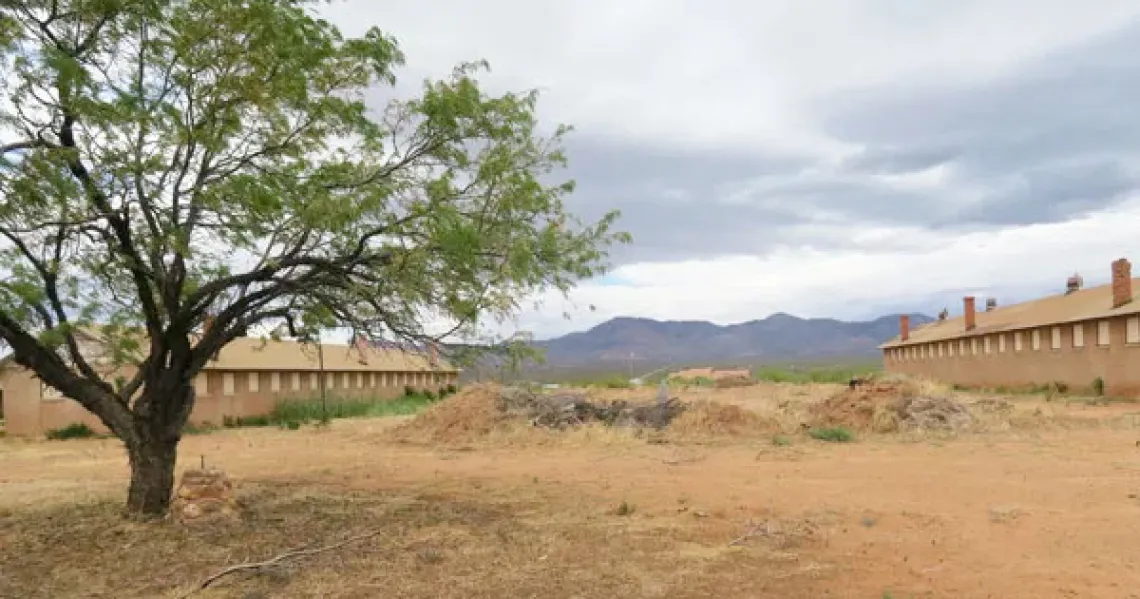
Camp Naco, just north of the Mexico border in southeastern Arizona. Photo by Helen Erickson.

On June 22, 2021, CAPLA Heritage Conservation Project Director Helen Erickson published the essay “Buffalo Soldiers on the Southwest Border” in The Field, the blog of the American Society of Landscape Architects (ASLA) Professional Practice Network. In its introduction to the essay, the ASLA notes how it “highlights the importance of documenting historic landscapes for perpetuity”—and in particular, a historic Black landscape.
Image
Helen Erickson

Helen Erickson, Heritage Conservation Program Project Director.

Erickson explores Camp Naco alongside the larger role of African-American soldiers in southeastern Arizona. The camp, which was constructed in 1919, is located in the valley of the San Pedro River and was home to rotating troops from the 10th U.S. Calvary Regiment—nicknamed “Buffalo Soldiers.” It is also “unique in that it was built almost entirely of adobe, a circumstance which explains its survival to the present day,” writes Erickson.

Learn more about Camp Naco and Buffalo Soldiers on the Southwest border by reading the essay.

Erickson, who holds a Master of Landscape Architecture and Certificate in Heritage Conservation from CAPLA, joined the college faculty in 2017 after working with the Drachman Institute for seven years on Cooperative Ecosystem Studies Unit-related projects. The national ASLA coordinator for the Historic American Landscapes Survey, she also holds a BA from Harvard University and a Master of Music from the Yale University School of Music.


Subscribe to The Studio

Sign up for CAPLA's monthly e-newsletter to get the latest news and events, insights from faculty and leadership, profiles of students and alumni and more.

Subscribe Now

Latest CAPLA News, Projects and Profiles

Image
Jackie Hogan Headshot

Research-Based Approach to Architecture: Jackie Hogan M.Arch + MS.Arch ‘25

Jackie Hogan (’25 M.Arch + MS.Arch) is a dual-degree graduate of CAPLA whose work bridges architectural practice and research-driven design. Drawn to architectural history, theory and ethics, she pursued the M.Arch + MS.Arch dual degree to explore how research can shape meaningful design decisions. During her time at CAPLA, she engaged in community-centered design through Laura Carr’s studio working with the Tuba City community and completed a thesis examining architecture’s role in disaster relief and climate-related emergencies. Now working at Line + Space, Hogan brings an evidence-based approach to projects, applying research to create thoughtful spaces that connect people, culture and the environment.

Image
Block Up

CAPLA Lecturer and Alumni Win 2025 AIA Arizona Ideas Competition

Senior Lecturer in Architecture Oscar Lopez and three CAPLA alumni won first place in the 2025 AIA Arizona Ideas Competition for their proposal “BLOCK UP.” The project reimagines the urban tower as a vertical civic framework for Phoenix, integrating public space, housing and climate-responsive design into a shared, adaptable structure. Developed through close collaboration between Lopez and alumni Sal Arellano, Trevor Watson and Cameron Noble, the proposal explores how density can expand community and access beyond the street level, highlighting CAPLA’s impact on forward-thinking, civic-minded design in Arizona.

Image
The white facade of Mission San Xavier del Bac is seen against a clear blue sky. A paved path leading to the mission passes through an earthen wall fronted by cactus and other desert plants.

Rehabilitation of the Retablo Facade at San Xavier del Bac | Lecture by Starr Herr-Cardillo

Learn about ongoing work to preserve decorative finishes and restore missing and damaged elements of the retablo facade of Mission San Xavier del Bac. This work is supported by the Semiquincentennial Grant Program, administered by the National Park Service.