Alumna and Architect Diane Reicher Jacobs Shares Journey and ‘Triple Dare’ with Graduates
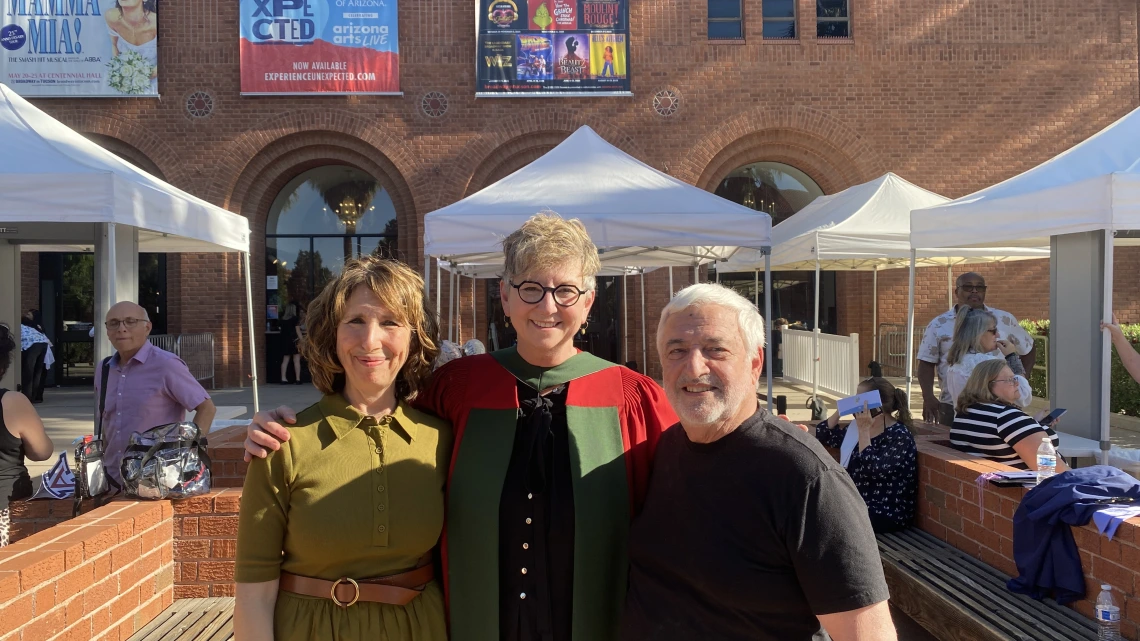
From left, commencement speaker Diane Jacobs, Dean Nancy Pollock-Ellwand, and former dean Chuck Albanese share a moment after the 2025 CAPLA Spring Convocation Ceremony at Centennial Hall.
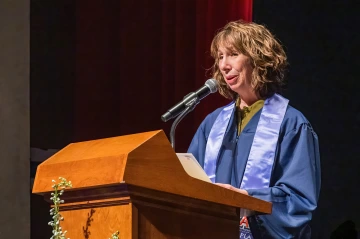
Diane Jacobs, FAIA '88, architect and alumna of CAPLA, delivered the 2025 CAPLA Spring Convocation address, offering graduates reflections on her career in architecture and the values that have guided her practice: truth, beauty, and love.
Rather than offering conventional advice, Jacobs framed her remarks through the lens of personal experience. She recalled arriving at the College of Architecture in Tucson in 1983, uncertain but determined, more motivated by practicality and family expectations than a burning passion for design. What followed was a transformative education—one that challenged her to truly see, think critically, and create with intention and care.
Jacobs shared candid memories of her early career in Boston, where the architectural profession at times felt disillusioning and overly technical. But by remaining curious and resilient, she eventually found joy in the human-centered power of design—especially when clients “fell in love” with the spaces she helped shape.
In 1995, Jacobs returned to Arizona and co-founded Holly Street Studio, where she has continued to balance business, family, and purpose-driven design. Her projects—ranging from ramps and public parks to civic and cultural buildings—have gained recognition not through spectacle, but through thoughtful simplicity and impact.
At the core of her work are the values of clarity (truth), environmental harmony (beauty), and human connection (love).
“It’s time to build. Whether it’s a shed or a hospital or a riparian habitat or a festival or a weekly ‘feed the neighborhood’ event. Your presence and participation is essential, not just to build, but also to unbuild, plant, plan, teach, write and everything in between," she said.
As her speech came to a close, Jacobs turned directly to the graduating class with a sincere and spirited message: "I believe most of you will, like me, never feel ready, but you are without a doubt, ready at least, to begin."