

Gather Light: ARC 201
Students in ARC 201, taught by Christopher Domin, Siri Beidler, Grace McEniry, Oscar Lopez, Stefan Mostert and Brendan Sullivan Shea, recently completed a project titled “Gather Light.”
Take a look at the work of these talented students: Kate Schweinberg, Dante Manuel Franco, Magdalena Margarita Annala, Emily McDowell, Laura Bennett, Ivanna Gamez, Jake Larson, Will Meierding, Renata Ascencio Gonzalez and Camila Fragoso.
Narrative by C. Domin. Q&A prepared by B. Shea.
Project narrative:
At CAPLA, architecture students start by learning core principles that help them understand both the region they live in and how it fits into a larger world. The program emphasizes paying close attention to the natural environment, especially the desert, through hands-on, repeatable exercises that help students connect with the landscape.
Early on, students explore how light, materials, structure and space relate to one another, using their own bodies as a reference for scale and sensory awareness. The design studio begins with drawing from observation and careful reflection. These exercises lead students into studying plants of the Sonoran Desert and how they’ve adapted to heat and dryness. Through direct observation and drawing, students and faculty discuss how the environment shapes design.
The slow, gradual development of the desert landscape becomes a model for the slow, attentive process of drawing. As ideas build over time students learn to capture essential features of desert plants such as cacti and agave. These quick, expressive sketches reveal how plants manage heat, conserve water and protect themselves.
Drawing becomes a research tool, helping students understand how natural systems work. By studying the desert in this way, students develop a sense of responsibility and respect for the environment. Ultimately, the goal is to encourage future architects to design in partnership with nature rather than in opposition to it.


Figure 1, 2 - Kate Schweinberg + Dante Manuel Franco
Through a variety of exercises the 2nd year studio asks students to study existing conditions as the basis for constructing new architectural knowledge. In that context, can you briefly describe your process and outcomes in Gather Light?
“We examined the systems and interactions between the existing conditions, the earth, and the sun to develop a project that acknowledged and enhanced their relationship,” students Kate Schweinberg and Dante Manuel Franco said. “This led to an extension of the existing circulation and interaction, which improves the experience of the outdoor space.”


Figure 3, 4 - Renata Ascencio Gonzalez + Camila Fragoso
The education at CAPLA uses the complexity and intelligence of our local environment as a living laboratory for learning critical and creative design principles of global relevance. Expand on your process of nature observation, translation-through-drawing and the iterative development of a generative operation.
“We began by visiting the University [Joseph Wood Krutch] Garden to closely observe the desert landscapes, focusing on the prickly pear cactus and creating detailed sketches that highlighted its notable features, such as the circular pads and the diagonal arrangement of its pricks,” students Renata Ascencio Gonzalez and Camila Fragoso said. “Using these drawings, we translated our observations into a generative order system that combined the plant’s circular units with a grid derived from the prick pattern.”


Figure 5, 6 - Jake Larson + Will Meierding
The Gather Light project challenged you to explore a wide set of relationships—from body to building, nature to geometry, module to aggregation, structure to material joint, existing to new—as your team worked to define a canopy that acted to thoughtfully filter light and thicken the threshold between interior/exterior. How did 2D representation in orthographics, diagrams and oblique drawings structure and support your design process?
“Everything is intentional. Not just in design, but also in presentation and representation,” students Jake Larson and Will Meierding said. “By analyzing different types of 2D representations and the ways they communicated design elements, we curated a set of drawings and diagrams, each with a specific story and purpose, ranging from human proportion to spatial quality to the translation of light.”


Figure 7, 8 - Laura Bennett + Ivanna Gamez
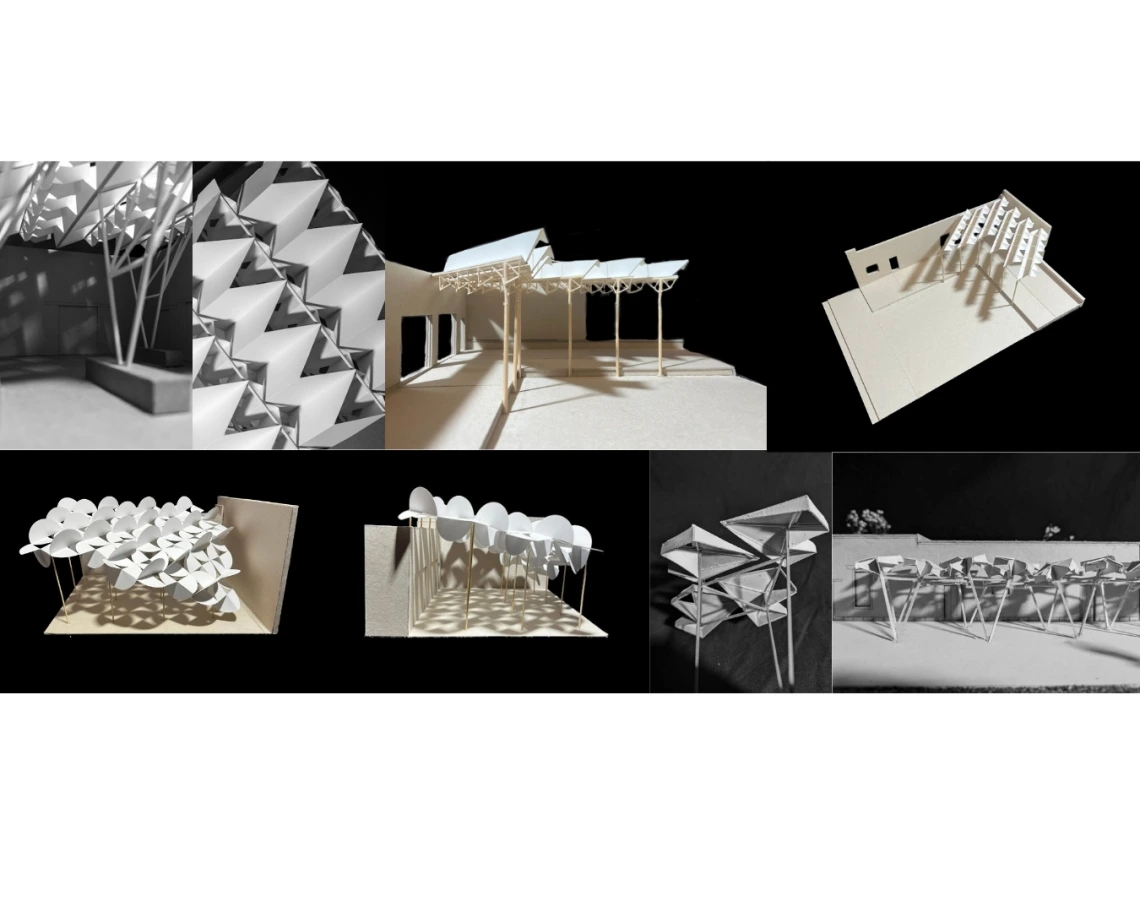
What were the 3D challenges and opportunities for the project discovered in scaled models in basswood/chipboard/ paper? How did you conceive of the existing condition of the site and the new intervention through models?
“Building physical models helped us understand how our modular idea becomes real space. It allowed us to test how the modules can connect, stand and cast shade at different times of the day. It was challenging to translate the tight, curved pattern of the agave into materials that want to stay straight, but this also pushed us to refine the design of each joint,” students Laura Bennett and Ivanna Gamez said. “Modeling both the existing site and our intervention together, made it easier to see how people would move under the structure and how the new intervention creates a more welcoming threshold into the building.”
Figure 9 - Selection of Plan Oblique Drawings from Arc 201 Cohort
While most assignments in the studio have been formatted as individual, this assignment required teamwork. What role did collaboration play in the process and how did your partnership expand your perspectives?
“Collaborating in the studio allowed each of us to bring out our individual strengths. We were able to provide each other with real-time feedback and build on one another’s ideas,” students Magdalena Margarita Annala and Emily McDowell said. “Working together also helped us set clear deadlines and hold each other accountable. This was especially important with the short timeframe of the project.”
“Architecture at heart is a collaborative endeavor, and working closely with another person on this project allowed us to workshop ideas, hold each other accountable and share the workload,” students Jake Larson and Will Meierding said. “Working with a person who feels connected with your process and someone you can rely on creates a more fulfilling and productive experience and a more fluid and elevated design.”
Figure 10 - Selection of Retrospective + Generative Diagrams from Arc 201 Cohort
What major lessons did you learn from the project? What are the most meaningful takeaways that you will carry forward in your academic and professional career?
“The most meaningful lessons that we take from this project, is how much design can grow from careful information of nature and from responding to a real site. We learned the value of iteration, how testing ideas through drawings and models leads to stronger solutions, and how light and shadow play a key role in shaping architecture,” students Laura Bennett and Ivanna Gamez said. “We also gained skills in effective communication, problem solving and collaboration that will be essential both in studio work and professional practice.”
Figure 11 - Selection of Model Photographs from Arc 201 Cohort
Lastly, what’s your favorite kind of light? Can you identify and name a particular quality, quantity, type or typology of light?
“Filtered natural light is our favorite kind of light,” students Kate Schweinberg and Dante Manuel Franco said. “Rays of light filtered by natural and built conditions create beautiful pockets of light that project upon the ground, allowing for the opportunity of pattern and shape, much like those created by our shadow caster.”
“Light is a beautiful tool in architecture, and our favorite kind of light to play with is natural light,” students Renata Ascencio Gonzalez and Camila Fragoso said. “In general, indirect natural light has the potential to define spaces; its ability to diffuse across surfaces creates soft atmospheres, which we noticed and explored throughout this project.”


