
Lecture Recap and Video: Lisa Schrenk on 'An Architect's Laboratory: The Early Studio of Frank Lloyd Wright'
March 18, 2022
Who
Lisa Schrenk, Associate Professor of Architectural History, The University of Arizona
What
CAPLA Lecture Series Event
When
February 16, 2022
Image
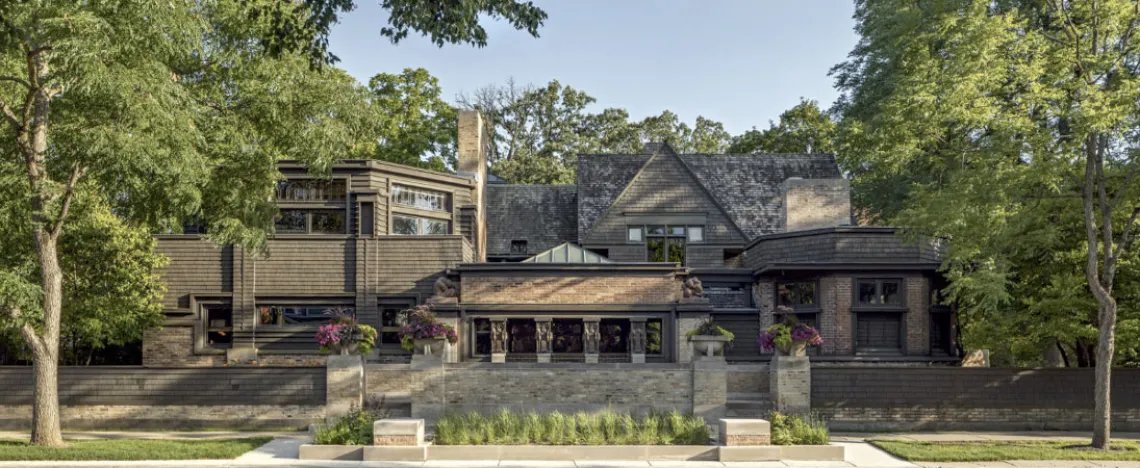
Frank Lloyd Wright's Oak Park studio

Frank Lloyd Wright's Oak Park studio. Photo by James Caulfield.

Between 1898 and 1909, Frank Lloyd Wright’s residential studio in the idyllic suburb of Oak Park, Illinois served as an architectural laboratory as its owner formulated his iconic design ideology and matured into a leader in his field. This talk will explore the significance of the Oak Park studio in the development of Wright’s early career, including the numerous changes he made to his workplace as he experimented with building elements and the shaping of space. It will also address the evolution of the architectural operations that took place within its walls and the impact of its unusual suburban location.


Watch the Lecture


About Lisa Schrenk

Lisa D. Schrenk PhD is associate professor of architectural history at the University of Arizona and former education director of the Frank Lloyd Wright Home and Studio Foundation (Frank Lloyd Wright Trust). Her research on international expositions and the early work of Frank Lloyd Wright has resulted in numerous publications, including the books Building a Century of Progress: The Architecture of Chicago’s 1933-34 World’s Fair and The Oak Park Studio of Frank Lloyd Wright. Schrenk has served on the Board of Directors for the Society of Architectural Historians and as president of the Chicago Society of Architectural Historians. She is a cofounder of the Institute for the Study of International Expositions and initiated the Women in Architecture Society at the University of Arizona. Her photography includes documenting works of architecture in over 85 countries, including while teaching on two around-the-world Semester at Sea voyages.


Subscribe to The Studio

Sign up for CAPLA's monthly e-newsletter to get the latest news and events, insights from faculty and leadership, profiles of students and alumni and more.

Subscribe Now

Latest CAPLA News, Projects and Profiles

Image
Group photo of four CAPLA students who are members of the ISAPD

CAPLA to host Indigenous Design Symposium focused on community, sustainability

CAPLA’s Indigenous Society of Architecture, Planning and Design (ISAPD) will host an all-day symposium on April 6, bringing together students, faculty and practitioners to explore Indigenous approaches to the built environment. Featuring Indigenous designers and supported by campus partners, the event will highlight community-centered design, sustainability and the role of Indigenous knowledge systems in shaping more responsible relationships with land.

Image
Six students and faculty work together to lift the frame of a wall for a house they are building in Agua Prieta

CAPLA students build housing in Agua Prieta during spring break

CAPLA students spent spring break in Agua Prieta, Sonora, building a home for a local family in partnership with Rancho Feliz. Working alongside community members, they gained hands-on construction experience while contributing to a reciprocal housing program designed to address affordability and climate-responsive design.

Image
Jackie Hogan Headshot

Research-Based Approach to Architecture: Jackie Hogan M.Arch + MS.Arch ‘25

Jackie Hogan (’25 M.Arch + MS.Arch) is a dual-degree graduate of CAPLA whose work bridges architectural practice and research-driven design. Drawn to architectural history, theory and ethics, she pursued the M.Arch + MS.Arch dual degree to explore how research can shape meaningful design decisions. During her time at CAPLA, she engaged in community-centered design through Laura Carr’s studio working with the Tuba City community and completed a thesis examining architecture’s role in disaster relief and climate-related emergencies. Now working at Line + Space, Hogan brings an evidence-based approach to projects, applying research to create thoughtful spaces that connect people, culture and the environment.