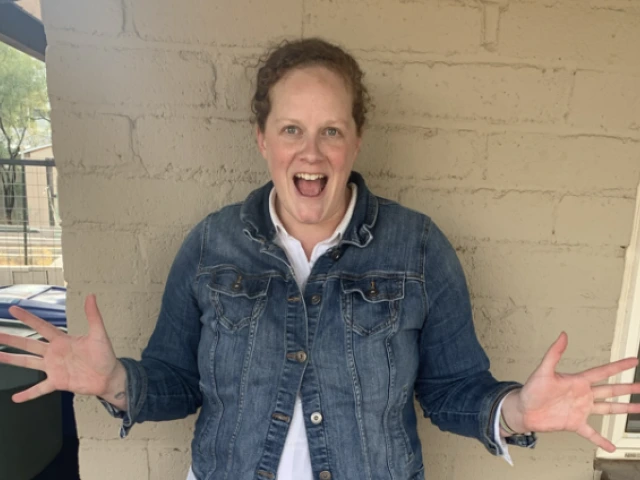
Teresa Rosano Receives Dual Honors at the 2025 AIA Arizona Design Awards

In November, the 2025 AIA Arizona Design Awards recognized architectural excellence across the state, and Associate Professor Teresa Rosano received two of the evening’s highest honors: the AIA Arizona Architects Medal and a Community Design Award for a student-led capstone project.
Rosano said the Architects Medal carries deep personal significance.
“Receiving the Architects Medal feels incredibly meaningful to me,” she said. “It’s a recognition of the path my career has taken, a journey I describe as unfolding in two acts: Act I - Practice, where I learned to create architecture, and Act II - Education, where I’ve learned to share that experience with students.”
Rosano earned her B.Arch from CAPLA in 1994 and co-founded Ibarra Rosano Design Architects in 1999. The firm has gained national recognition as one of Arizona’s top design firms for its modern desert architecture.
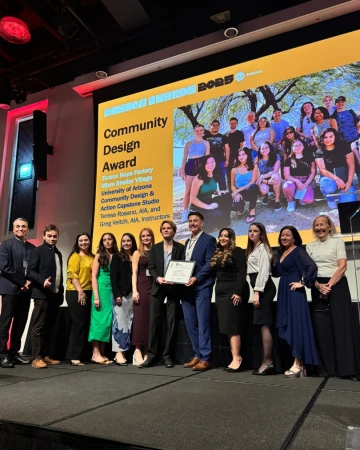
She added that the night became even more meaningful when her students were honored with the Community Design Award. Rosano said celebrating with students, colleagues and community members was a standout moment.
“Their excitement, their pride and their presence made the moment feel larger than anything I could have experienced by myself,” she said.
The Community Design Award recognized the Tucson Hope Factory Micro Shelter Village, a project developed through the Community Design & Action Capstone Studio, taught by Rosano and Greg Veitch.
The final capstone project for 16 students was intended to serve Tucson for years to come. With their prototype of an 8-by-12-foot micro-shelter, the hope is they've laid the groundwork for a network of similar shelters for unhoused people in Southern Arizona.
The micro-shelter project was a partnership among CAPLA's Drachman Institute, the School of Architecture, the City of Tucson, St. Francis Shelter Community and the Tucson Hope Factory. The Drachman Institute is an outreach unit in CAPLA that helps connect architecture students with projects that serve community needs. St. Francis Shelter Community and the Tucson Hope Factory serve unhoused people in Southern Arizona.

Ryan Smith, director of the School of Architecture, said Rosano’s studio is demonstrative of the lessons faculty are teaching within the school and college.
“Our students are hungry for real impact - tangible evidence - that architecture can improve the human condition, he said. “Our students are learning that making change happens when you lean in, stay curious, build skills with intention, and act with confidence.”
For Rosano, the recognition reflects both her professional practice and her dedication to architectural education.
“This award stands on its own, but for me, it’s also a beautiful reminder of why Act II matters so deeply – and a testament to CAPLA’s impact on the architectural community here in Arizona,” she said.
Rosano has received multiple accolades for her teaching. Earlier in 2025, the Association of Collegiate Schools of Architecture (ACSA) named her the winner of the Distinguished Professor Award. In 2024, she was honored with the Gerald J. Swanson Prize for Teaching Excellence from the University of Arizona. In 2023, she was named AIA Arizona Educator of the Year and received the Margaret M. Briehl and Dennis T. Ray Five Star Faculty Award.