

The Washington Post Interviews CAPLA Professor on Creating ‘Cool Corridors’ to Counter Extreme Heat
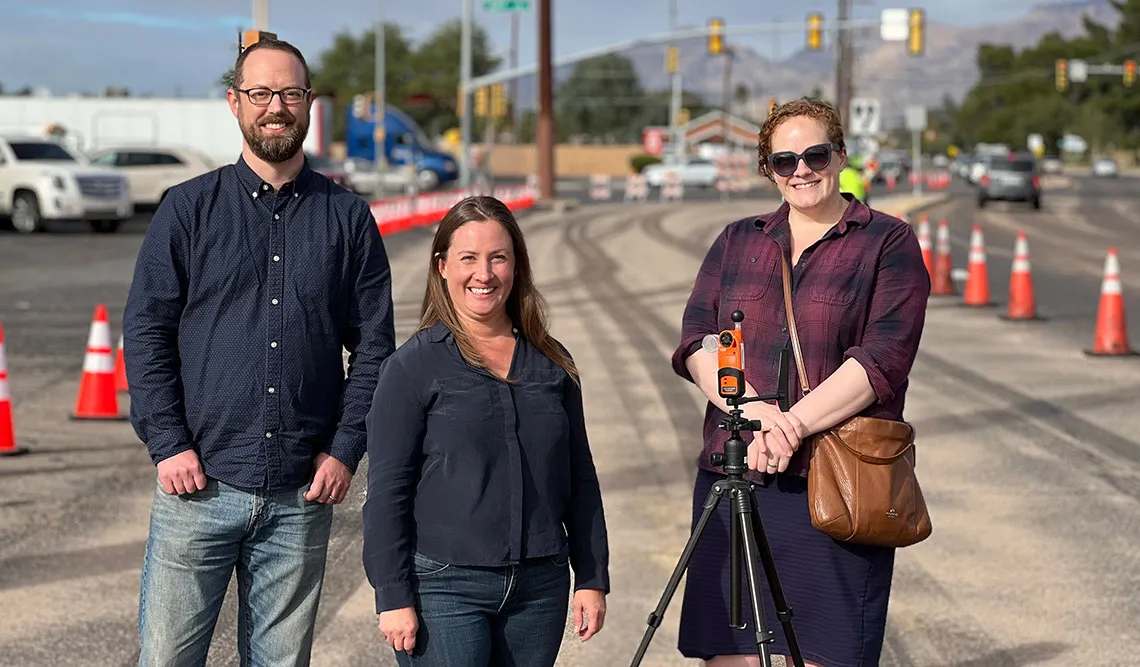
Researchers Ladd Keith, Nicole Iroz-Elardo and Kristina Currans onsite during Tucson's "cool pavement" street surface application in December 2021.
The University of Arizona College of Architecture, Planning and Landscape Architecture’s Ladd Keith, an assistant professor of planning and sustainable built environments, was interviewed by The Washington Post’s Lori Aratani on July 8, 2022: “As temperatures rise, this research could help cities stay cool.”
With fellow researchers Kristina Currans, CAPLA assistant professor of urban planning, and Nicole Iroz-Elardo, assistant professor at Willamette University, Keith is working with the City of Tucson to explore ways to reduce the urban heat island effect via “cool corridors” and the city’s Cool Pavement Program. The researchers are collecting data on an application currently being tested on a busy city boulevard that “can make walking and biking more tolerable and extend the life of streets and roads,” notes Aratani.
In the interview, Keith discusses how he became interested in studying the impacts of extreme heat on communities, the concepts behind cool corridors, the need for thermal safety year round, the inequitable community impacts of extreme heat, the need for heat resilience planning by communities, what’s going on with Tucson’s Cool Pavement Program, and how heat resilience must also be considered as part of governance structures with other climate risks.
Read the full interview on The Washington Post.
Keith, who joined CAPLA in 2009, is an interdisciplinary researcher with over a decade of experience planning for climate change with diverse stakeholders in cities across the U.S. His current research explores heat planning and governance with funding from the National Oceanic and Atmospheric Administration, Centers for Disease Control and Prevention and Department of Transportation. In addition to founding and leading CAPLA’s Bachelor of Science in Sustainable Built Environments, Keith teaches public participation and dispute resolution as well as climate action planning.


