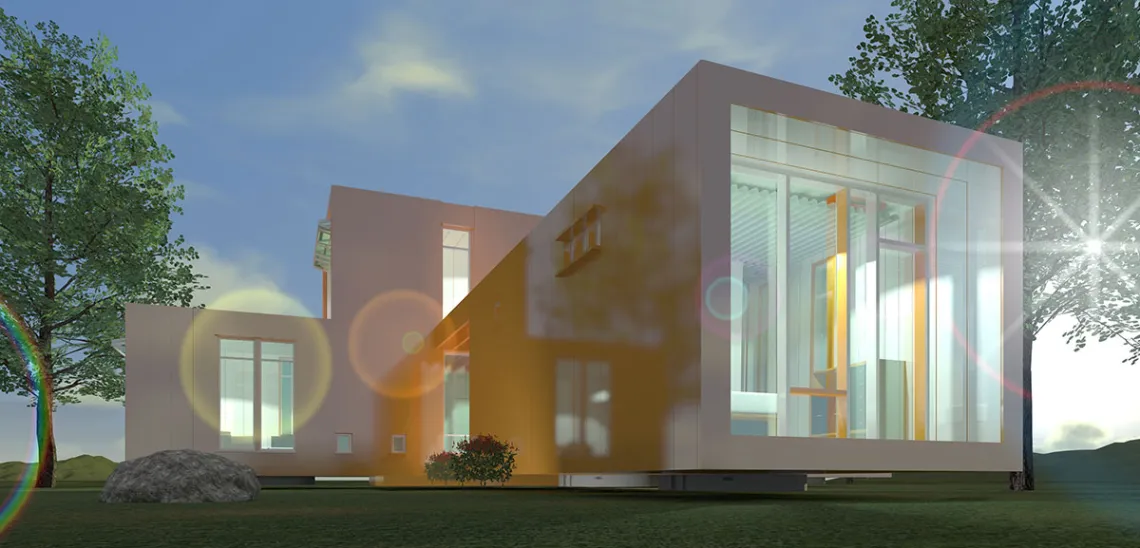
re-House Modern: Damon Leverett, Senior Lecturer in Architecture

June 30, 2020
Who
Damon Leverett, Senior Lecturer in Architecture
What
Faculty Work | Prefabricated Modular Housing
When
2011
Image
re-House Modern, by Damon Leverett

The research project re-House Modern by Damon Leverett is a  prefabricated modular housing  concept made of recycled HDPE plastic that is formed into individual building components. A housing kit is developed either in parts, components or sections. Sections are complete rooms of a home that are arranged in various layouts to develop a unique home. The project seeks to address forms of micro living and is also geared toward addressing disaster zone emergency housing. 


Image Gallery

Click a thumbnail below to view a larger image and begin slideshow:


Learn more about Damon Leverett on his faculty page.

All images are by Damon Leverett and may not be used or reproduced without express written permission of their creator.

Latest CAPLA News, Projects and Profiles

Image
arc 201

Gather Light: ARC 201

Students in CAPLA’s ARC 201 studio, guided by faculty including Christopher Domin and others, completed the "Gather Light" project focused on understanding and designing in harmony with the Sonoran Desert environment. Through observation, drawing, and modeling, students explored how light, nature, and architecture interact. Key activities involved studying desert plants, translating their forms into design systems, and developing canopies that filter light and enhance outdoor spaces. The project emphasized hands-on learning, teamwork, and iterative design using 2D and 3D representations to create thoughtful architectural interventions that respect and respond to the desert landscape.

Image
Chris Tucker Design Pedagogy Award

Lecturer Christopher Tucker wins AIA Design Pedagogy Award for innovative Abiotic Studio

Christopher Tucker, a lecturer in architecture at CAPLA, received the American Institute of Architects’ Design Pedagogy Award for his Abiotic Studio, a fourth-year course that challenges students to engage with ecological realities and reimagine post-industrial landscapes through more-than-human perspectives.