

Designing for the Human Factor: Dyron Murphy ’88 B.Arch
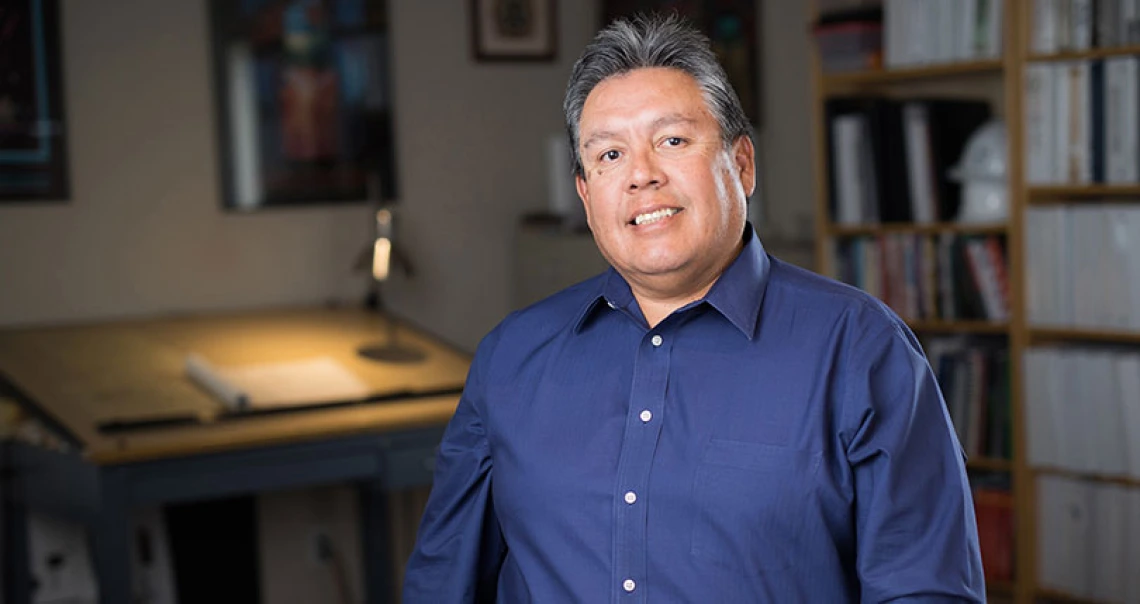
Dyron Murphy ’88 B.Arch, President, Dyron Murphy Architects, Albuquerque, New Mexico
“My work has been dedicated to helping people through architecture and planning for ‘the human factor’—i.e., looking at how end users experience their environments and designing accordingly.”
Dyron Murphy, who is from Window Rock on the Navajo Nation, learned many things as a Bachelor of Architecture student—time management, design skills, flexibility—but what he didn’t anticipate was how close his cohort would become and has since remained.
What brought you to architecture and the University of Arizona?
I always liked learning about how buildings were put together, so when I was in high school I took a drafting class and knew almost immediately that I wanted to study architecture. Additionally, I had an uncle who studied architecture. I explored colleges and the University of Arizona was ranked one of the highest.
I was accepted and moved from Window Rock on the Navajo Nation to Tucson in 1982. It was a huge change and walking onto campus was mind-blowing. Where I was raised there wasn’t always a sense of urgency, and I realized very early on that I needed to get busy.
I was also the only Native American in my architecture class. I’m pleased to see that the student body at CAPLA is much more diverse now.
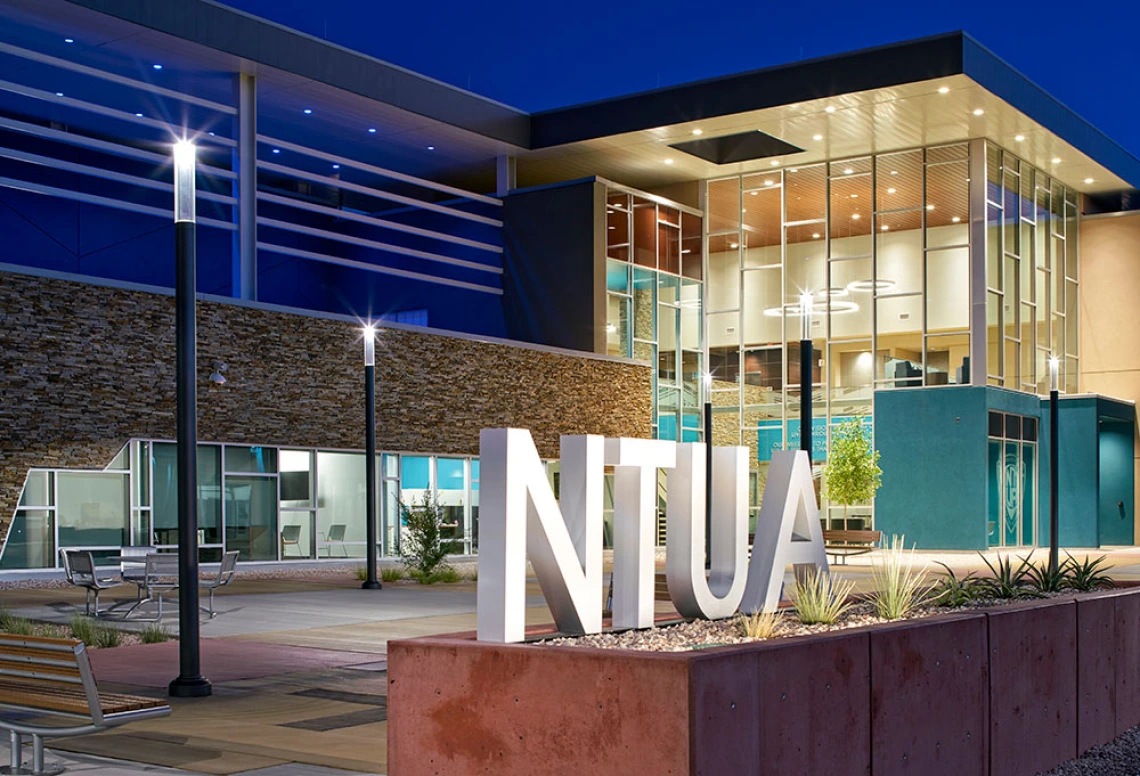
The Navajo Tribal Utility Authority headquarters, designed by Dyron Murphy Architects. Photo by Patrick Coulie.
What did you find most challenging and also most rewarding in the Bachelor of Architecture program?
Juggling schedules and time management proved to be most challenging because I came from a community where life was slow and if you didn’t get it done today, there is always tomorrow. But at CAPLA it had to get done! After a while I figured it out, and from then on tried to maintain a balance.
The closeness of our cohort in the B.Arch was very rewarding. We all still keep in touch and got together at the last in-person Homecoming.
Additionally, my architectural education prepared me to be flexible. When we were in college, everything was drawn by hand. I had to create 3D building perspectives by hand and that is a skillset relating to space and scale I’ve maintained throughout my career.
When I moved to Albuquerque after college, I continued to draw by hand. When CAD came about, I was hesitant and had to learn on the fly. But I still applied my hand-drawing skills in combination with the technology, and so was able to use CAD more meaningfully than just the tech part. Even now, when I attend meetings, I sketch by hand for my clients (but my younger employees have to use a computer!).

The Montezuma Creek Community Health Center, designed by Dyron Murphy Architects. Photo by Patrick Coulie.
Tell us about your career.
After graduating in 1988, I moved back to Window Rock and worked for the Navajo Nation for four months in the Tribe’s design and engineering department. When funding for my job was not renewed, I accepted a job in Albuquerque and have lived there ever since.
At one of my first design jobs in Albuquerque, the firm’s owner moved to Washington, D.C. for two years to focus on the National Museum of the American Indian. I was asked to help with marketing and client work in his absence, which was challenging because I had no experience. I had always been behind the scenes. But I found success in putting together the proposals and interviews and winning commissions—and eventually realized I could run my own firm.
I started Dyron Murphy Architects, PC in 2001. We are an architectural planning and design firm that provides a full range of integrated design and construction administration services, including new, renovation/addition and multi-phase, long-term projects. Our priority is infusing local culture with contemporary architecture principles. For more than 20 years now, we have been dedicated to helping people through architecture and planning for “the human factor”—i.e., looking at how end users experience their environments and designing accordingly.

Interior of the Montezuma Creek Community Health Center, designed by Dyron Murphy Architects. Photo by Patrick Coulie.
What has been your most compelling architectural project?
That would be the Navajo Tribal Utility Authority (NTUA) building in Fort Defiance, New Mexico. NTUA is the area’s main provider of gas, electricity, water and broadband. In the summer of 1985, when I was still in college, I interned at NTUA and they asked me to work on a design concept and conduct research for a new headquarters building. I spent three months putting together information for this huge building that aimed to put hundreds of employees under one roof; I even built a model for them. At the end of my summer term, I presented the project and model—I learned a lot from that project. For me, it was very fulfilling work and a really important experience, even though the building was never constructed.
As I moved through my career, I thought periodically about the project, but it wasn’t until well after I started my own firm that the project came full circle. It finally went out to bid and my firm was selected. We finished the building, which is designed using LEED principles, in 2019. It was a pleasure to work on the renewed project; I knew a lot of people who were still working for NTUA, and they remembered me from that summer internship.

Headquarters of the Navajo Tribal Utility Authority, designed by Dyron Murphy Architects. Photo by Patrick Coulie.
What advice do you have for those who are considering architecture as a career?
Students today have so many options on career choices and how they want to use their degree. They need to think about what is meaningful to them. Find out what you really want to do because you’re going to do this the rest of your life. School sets the stage of where you’re headed and how you will fulfill your lifelong career and work. Think about how you interact with others.
Technology is important and provides so much access. Try to diversify your talents and yet not be only a generalist. Discover opportunities for specialization early on, such as spec writing, an integral part of what we do—describing the buildings we design—but which not many architects like to do. If you find spec writing to be of interest, you can make a career out of that. It is technical but at the same time you can infuse your ideas about the material, particularly in an environmental and geographic context.


