

Learning as Rich Experience: Sandra Bernal Cordova, Lecturer and UArizona Hispanic Serving Institution Fellow
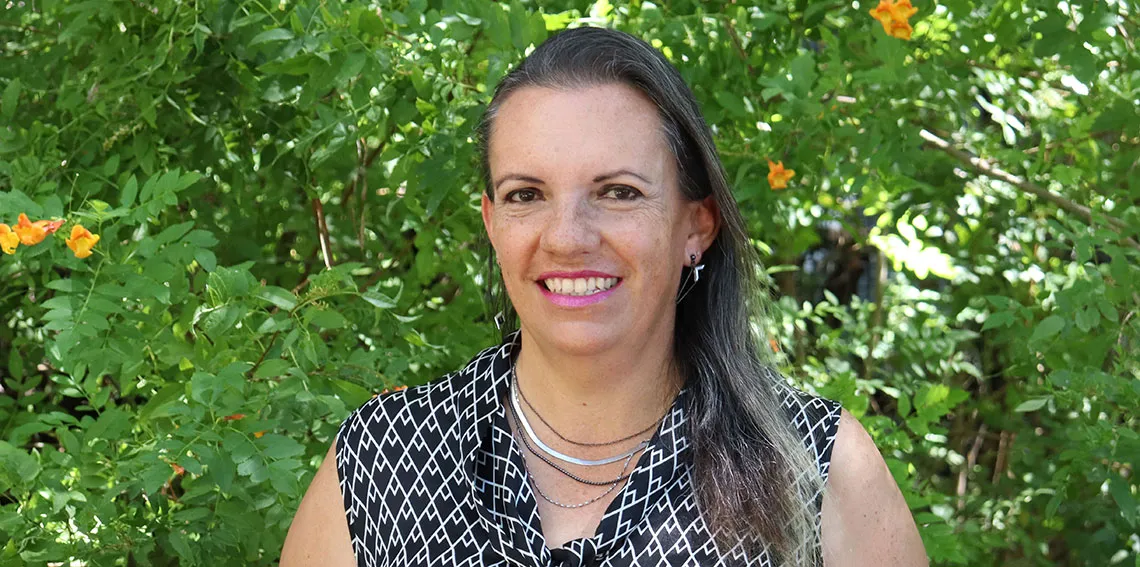
Nine Questions with Sandra Bernal Cordova, Lecturer and UArizona Hispanic Serving Institution Fellow
My research, service and teaching share common ground, and I always bring new findings to the classroom in the form of data, news, tools, storytelling or inquiry. This includes state-of-the-art instructional design, so the learning is a rich experience.
What brought you to the College of Architecture, Planning and Landscape Architecture?
I originally joined CAPLA in 2010 as a Master’s in Planning student. Life happened, and I rejoined as a graduate teaching assistant years after while studying for my PhD in Arid Lands Resource Science. When I was a doctoral student, CAPLA faculty members Nader Chalfoun, Omar Youssef and Phillip Stoker invited me on many occasions to serve as a judge of final student projects and to present to their classes about health and environmental design topics. When I earned my doctorate in 2018, I became a lecturer, joining research and project endeavors with professors Altaf Engineer and Courtney Crosson.
What is your current research and what most excites you about this work?
My research is on environmental health and sustainability using a mixed methods approach. Based on social constructivism, I research from individuals to macro-regions focusing on exposure to arid environmental conditions, including anthropogenically caused desertification. What excites me the most is expanding knowledge about the intersection between socio-cultural solutions to sustainability, health and decision-making—such as the research with Altaf Engineer on pre- and post-COVID-19 synergies between research and practice in health and the built environment.
For the last year and a half, I have also been exploring environmental education strategies for the THRIVE Employee Engagement Program to deepen the participation of county employees and the public in the Sustainable Action Plan for County Operations. As a principal investigator, I have been working with the Pima County Office of Sustainability and Conservation and Mrs. Green's World.
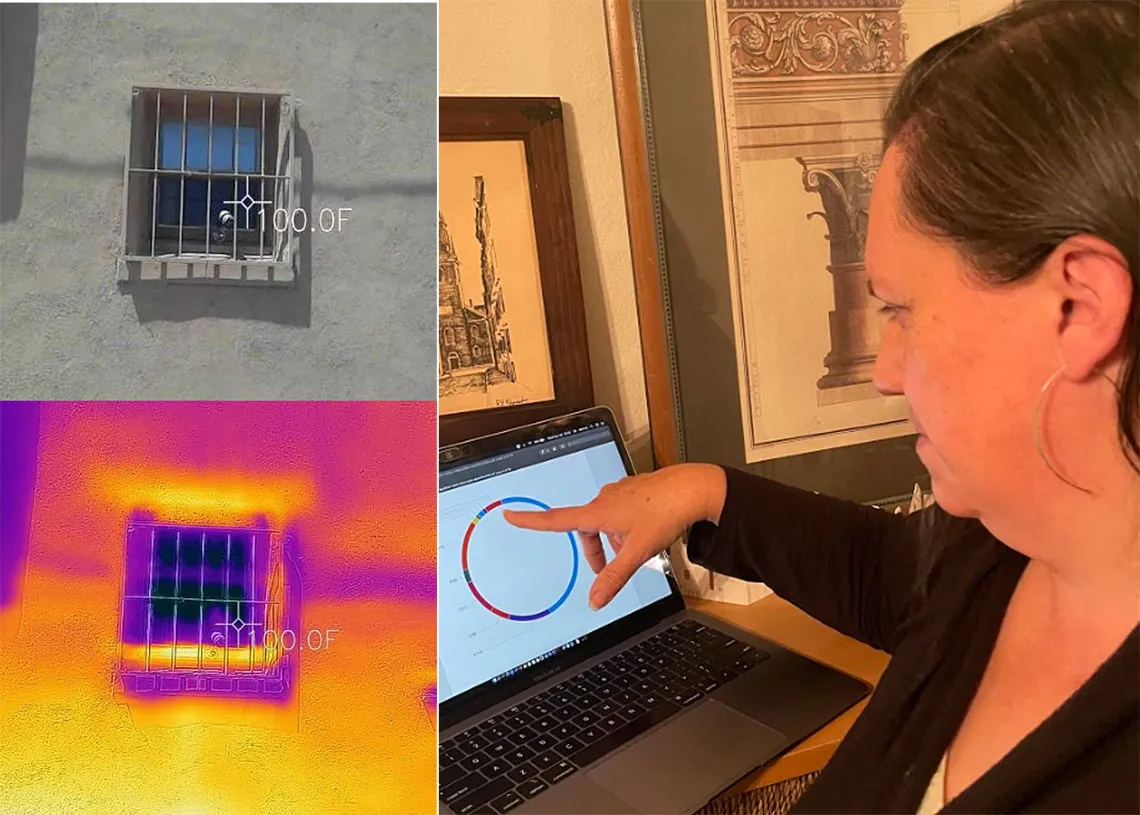
Building envelope assessment research conducted by Sandra Bernal Cordova from 2017-2021: thermal image supporting data collection on leakages for improving energy efficiency and indoor air quality. Images courtesy Sandra Bernal Cordova.
Tell us about your current service work, including as a UArizona Hispanic Serving Institution Fellow.
My service focuses on making sure the user experience is included in decisions in the building industry and in academia. To do so, I am a member of the US Green Building Council Arizona Market Leadership Advisory Board and Mountain Region Equity and Inclusion Committee. I also serve as a reviewer of abstracts, papers and presentations for the American Institute of Architects and Association of Collegiate Schools of Architecture, the Architecture Research Centers Consortium-European Association for Architectural Education 2022 International Conference and other field-related publications.
As a UArizona Hispanic Serving Institution Fellow, I extend my service to activities that link Mexicans to CAPLA, such as the interactions with the Consulate of Mexico in Tucson, UA International (formerly UA Global) and the Institute of Mexicans Abroad.
Tell us about your collaborations with other organizations across campus.
My College Teaching, Quality Matters and Adobe Creative Cloud certifications—initially taken to advance the learner-centered approach to higher education for the built environment and arid lands at CAPLA—have expanded to many collaborations across campus. I review courses using the QM rubric as part of the University Center for Assessment, Teaching and Technology. For the College of Humanities, I contribute to the best online education practices for two general education and two graduate-level courses in the Department of Classics. With the W.A. Franke Honors College, I collaborated on the Navigating Education in Borderlands summer program, enabling the Collaborative Online International Learning methodology to teach a seminar about the Sonoran Desert and the desert-inspired art and architecture. And with the School of Geography and Udall Center for Studies in Public Policy, I co-designed a multistage environmental health risk assessment for landfills and designed community engagement instruments for public and stakeholder participation in river restoration projects.

Aerial view of Kalacosopio for the University of Arizona's 2021 Day of the Dead celebration, a collaboration between the UArizona Office of the President, HSI, Consulmex Tucson, CAPLA, the W.A. Franke Honors College, College of Education and UArizona Faculty Affairs. Photo courtesy BG Boyd Photo.
Does your work have an architectural practice component?
Most of my architectural practices go to academic work such as teaching, research and service. I find opportunities to keep my project management and design skills up to date by joining review boards, judging presentations and collaborating on CAPLA projects and decisions. One service that connects my current work and my all-time passion for design is hosting art and project exhibitions in different venues in and out of the university. For example, I have curated desert-inspired art shows at the Consulate of Mexico, and coordinated the Day of the Dead tapestry at the USS Arizona Memorial at the UArizona Student Union in 2021.
What are you currently teaching, and what do you most enjoy about teaching?
I co-teach SBE 498 and 498H Sustainable Built Environments Senior Capstone with Joey Iuliano and Kenny Wong for the Bachelor of Science in Sustainable Built Environments on-campus and microcampus program at UPC Lima. In Spring 2023 I will also teach Water Efficiency in Building for microcampus students and PLG 211 Equitable Cities as a general education course.
Teaching, for me, is the greatest opportunity to impact people’s lives by guiding future professionals into the more responsible practice of their different areas of expertise within the built environment. However, I look beyond that: I see students as family members, influencers, decision-makers and society members who interact with the future-to-be. By connecting their inner selves with how the built environment should respond to their needs, the students reflect more and procrastinate less.
How do you bring your research and service into the classroom?
We all face health issues and use buildings. Therefore, what I research is never far from my students’ lives. My research, service and teaching share common ground, and I always bring new findings to the classroom in the form of data, news, tools, storytelling or inquiry. This includes state-of-the-art instructional design, so the learning is a rich experience.
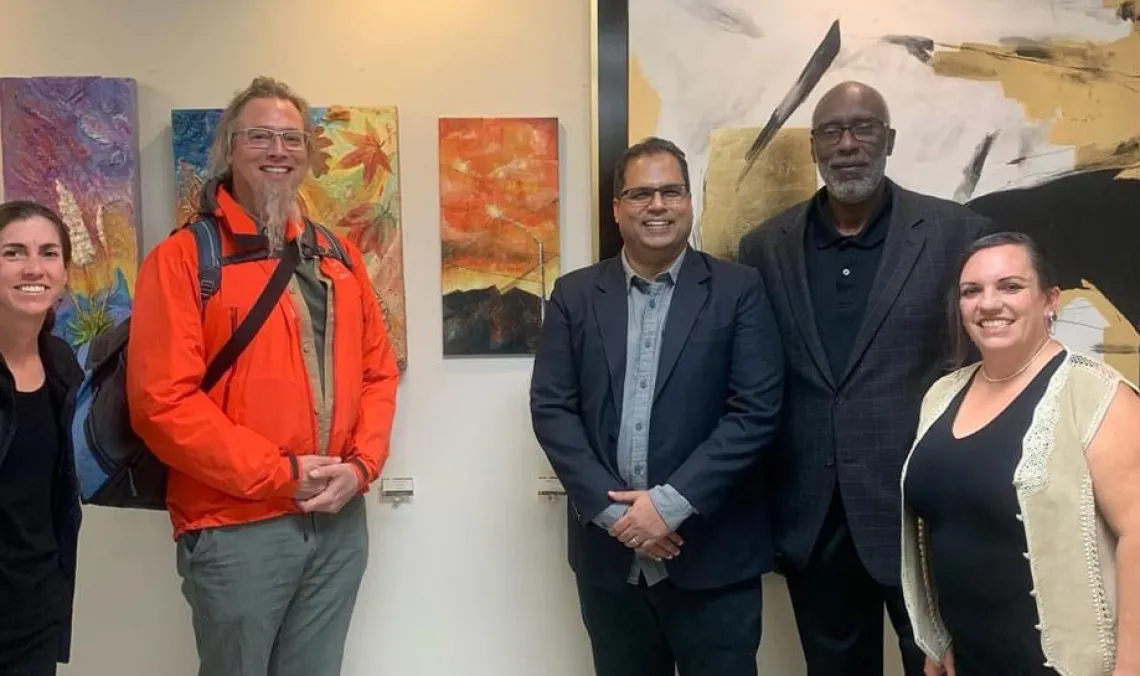
CAPLA faculty at the United by Art collective exhibition at the Consulate of Mexico. Left to right: CAPLA faculty members Courtney Crosson, Chris Trumble, Altaf Engineer, Damon Leverett and Sandra Bernal Cordova. Photo courtesy Sandra Bernal Cordova.
Beyond research, teaching and service, what are your passions?
Art curatorship and museum exhibition design are the reasons I became an architect in the first place. Then I found the splendid opportunity to help people who face harsh environmental conditions to spend quality time indoors using educational exhibition spaces as momentary shelters. I like visiting galleries and museums and love interacting with artists, as well.
Since I was 14 years old, I have practiced archery and have competed in international competitions as part of the Mexican national team. Twenty-five years later, I am part of the Wildcat Archery Competitive team and one of its faculty advisors.
I also enjoy bicycle rides with my family.
What advice do you have for CAPLA students exploring architecture, sustainable built environments or other degrees?
Never stop thinking as a user of the built environment. Your skillset will grow while studying here at CAPLA, but the best you can do is to first see your projects and assignments as real as possible from the simple human perspective.
Learn more about Sandra Bernal Cordova or learn how you can support Sandra and other world-class CAPLA faculty.


