

AI, the BS Savant and Autocognition | Lecture by P. Bryan Heidorn
This talk is a bird’s-eye view of the AI and machine learning landscape and its implications for academia. We’ll focus on some terms and discuss what AI is, is not, and what may come to pass. AI research and development can be viewed as an effort to automate physical and cognitive processes that previously had been limited to humans and animals. Since the 1960’s researchers have been developing highly focused processing systems that have characteristics of “intelligence”. These systems are widely deployed and underpin successful automation in fields as diverse as factory robotics, spelling and grammar correction, cancer diagnosis, and gaming. Much of the current hype is about the possibility of artificial general intelligence (AGI), which some think may be attained by generative AI and, in particular, large language models. I will argue that current models will not reach AGI, but rapid innovation of models, enabled by a large influx of cash and application of specialized AI may soon lead to AGI that has little similarity to human cognition. In this phase of AI evolution, before AGI, society, including academia, will find that many “intelligent” tasks are better performed by machines than by humans, with profound consequences for the perceived value of human effort. After AGI and super-intelligent systems, all bets are off.
Attribution: This abstract was written by P. Bryan Heidorn with help from a grammar checker and no other AI input. This abstract was then used as a prompt to GPT-5 along with many other AI interactions to collaboratively generate the slide presentation.
Watch the Lecture
About P. Bryan Heidorn
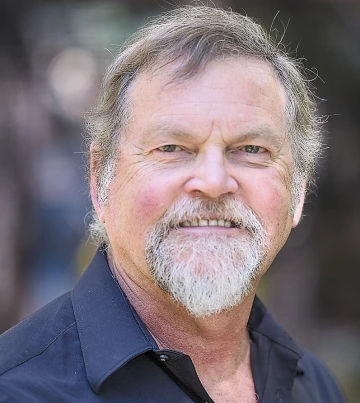
Professor P. Bryan Heidorn is the Associate Dean for Research for the College of Information Science. His related work began with the development of a dependency-based natural language processor in the 1990’s leading to a software company and then a dissertation that developed a procedural rule-based system that modeled human spatial cognitive processes and human vision models to make an image-generating natural language processing system. Over the years, he has used various machine learning models in his research. In recent years, he has served as a program officer at NSF and in multiple research administration roles at the University of Arizona. This experience has allowed him to become an informed observer of AI development through discussions with researchers and by reading and critiquing hundreds of grant proposals and research papers related to machine learning and AI.
AI-generated header image provided by P. Bryan Heidhorn.


