

Exploring Human-Landscape Connections: Adriana Zuniga ’10 MS Arch, Assistant Research Scientist

Seven Questions with Adriana Zuniga, Assistant Research Professor and MS Architecture Alumna
"I started my academic journey as an architect, but now I consider myself an interdisciplinary scholar who studies human-landscape interactions. I examine greenspace from multiple perspectives including urban design, water security, public health, urban resilience and environmental justice—working with a diversity of stakeholders and scientists with different backgrounds and from multiple institutions."
What brought you to the College of Architecture, Planning and Landscape Architecture—as a student and as faculty?
I came to CAPLA in 2008, after having practiced architecture in Mexico for several years. I came to pursue the Master of Science in Architecture with a concentration in Design and Energy Conservation. This experience changed my life! It was not until I was a graduate student at CAPLA that I realized the huge responsibility that professionals such as architects, urban designers and land planners have—because we alter the landscape dramatically, without fully understanding the impacts of development.
I wanted to learn more about the impacts of development and that is what drove me to pursue a PhD in Arid Lands Resource Sciences with a minor in Global Change, also at the University of Arizona. Once I finished my PhD in 2015, I joined CAPLA as an adjunct lecturer for the Bachelor of Science in Sustainable Built Environments program. Since then, I have been teaching sustainability-related courses at CAPLA and conducting research at the Udall Center for Studies in Public Policy.
What is your current research and what most excites you about this focus?
I started my academic journey as an architect, but now I consider myself an interdisciplinary scholar who studies human-landscape interactions. More specifically, I study greenspace in urban and periurban environments. Greenspace in cities is very important for both social and ecological systems. These spaces allow the functioning of the hydrological system (and all the processes derived from it) and are critical to human health and wellbeing. I examine greenspace from multiple perspectives including urban design, water security, public health, urban resilience and environmental justice—working with a diversity of stakeholders and scientists with different backgrounds and from multiple institutions. I value my networks very much because I have learned that it is through networks that learning can be expedited and we are more likely to affect change and hopefully make this world a better place.

Participatory design with middle school students in Nogales, Sonora, Mexico. Photo by Alejandra Huerta.
Tell us about your current service work and what you find most rewarding with this work.
My service work is centered around justice. I want to help create more just environments for everyone, including minorities, and at multiple levels—at my department, my school, my college, my university and my city. I want to learn (and in this process, help others also learn) how to embrace diversity, how to foster equity and how to ensure we include all voices in decision-making processes. This service work excites me because I represent many of the minority groups myself. I am an immigrant from Mexico, whose first language is not English. I attended graduate school as a “non-traditional” international student, as a single parent in her 40s. At a certain point in my life, I lived below the poverty level, and I know the difficulties associated with this. Finally, I am a female trying to build a career in environmental sciences, a STEM field. It excites me to realize that my perspective, what I bring to the table, is unique—most people have not experienced what I have—and that this experience can help alleviate stress or suffering for other people.
What is your role in the Udall Center for Studies in Public Policy, and how is it supported by your work at CAPLA?
My job at the Udall Center is very fulfilling. I am part of the Environmental Policy Program, and I conduct research on environmental issues with an applied public policy implication. And this is something that motivates me very much! I want my work to be meaningful and affect change. We involve decision-makers in the research process, ideally from the proposal stage, to know the types of information they need to make the best-informed decisions. We also plan events that bring together different stakeholders, so that they have meaningful interactions and learn from each other. The Udall Center is not just another research center at the university. Its mission is to help policymakers do a better job, and this has real-world implications that affect change.
My joint appointment at CAPLA supports my work at the Udall Center because I bring the perspective of the built environment professionals (architects, planners and landscape architects). Our work at the Udall Center is multidisciplinary, and we work in projects across the urban-rural continuum, form the local and regional level all the way to the national and international level. This is only possible because most researchers here have multiple backgrounds and work in joint appointments with other colleges across the university. For example, I have colleagues who work at the School of Geography, Development and Environment, School of Natural Resources and the Environment, Mel and Enid Zuckerhman College of Public Health and James E. Rogers College of Law.
In addition, my joint appointment is very valuable because I involve students in my research projects while providing hands-on opportunities for learning. Students appreciate a real-world experience, where theories learned in the classroom are experienced on the ground. In these projects we try to address equity issues around the distribution of green infrastructure, and students tend to be highly motivated towards this justice goal.
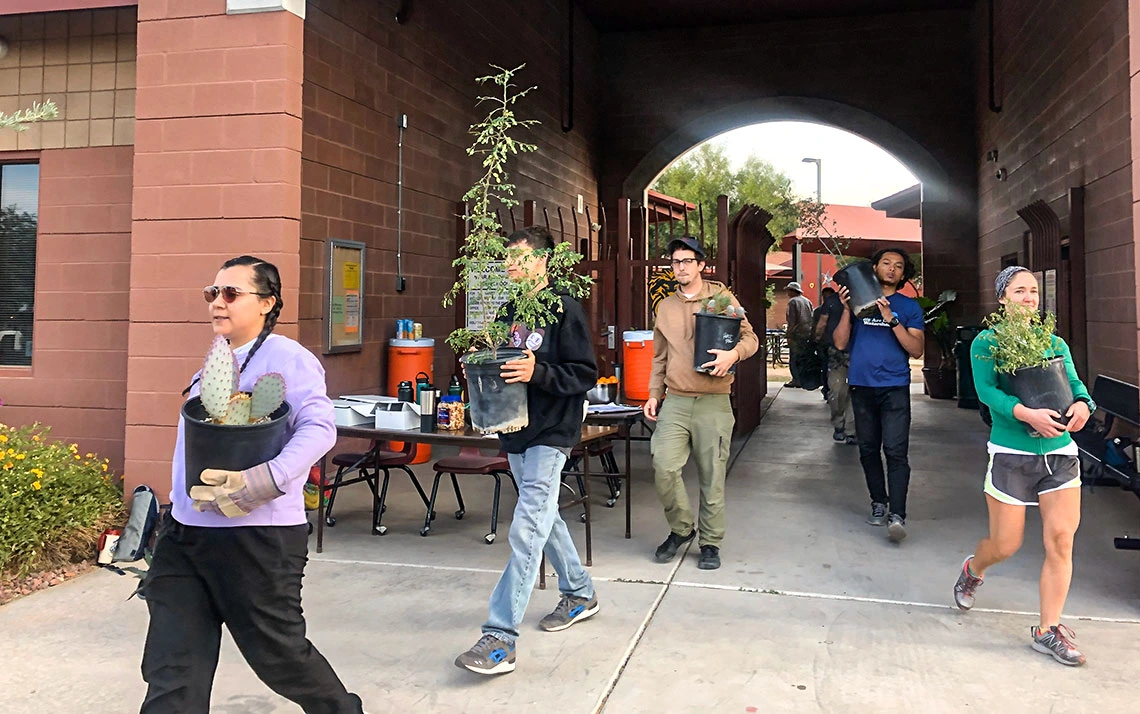
Students and faculty at work on the Tucson Verde para Todos green infrastructure project at Star Academic High School. Photo courtesy Adriana Zuniga.
Though you are no longer practicing architecture, how does your research and service impact architectural practice?
I try to influence architectural practice through my own research and my presentations. I believe that while architects can create wonderful buildings, they can also create a lot of damage that many people will have to suffer, and for a very long time. Therefore, it is critical that we train professionals and make them cognizant of the impacts of their decisions on our society and the environment.
I have learned that it is unlikely that one person (or a group of people) can have the best solution to other people’s problems. Therefore, it is essential that built environment professionals conduct participatory design processes because the users themselves are the ones who have the best solutions for the space they will be occupying and using. But they need help from architects, landscape architects and planners with translating their ideas into designs, plans and construction drawings that result in buildings/landscapes/cities that are functional and beautiful, have character and reflect a sense of place.
Nowadays, I work mostly at the neighborhood, city and even watershed scales. My research involves not only built environment professionals but also local governments, agencies, NGOs, utility companies and community members. Many of my research projects are local (Tucson) and regional (Sonoran Desert, Southwestern U.S.), focusing lately on the U.S.-Mexico border region (Ambos Nogales) and Las Cruces, New Mexico, in collaboration with CAPLA’s Nicole Iroz-Eraldo and Sandra Bernal. I also work in international projects with partners from all over the world, bringing to the table the perspective of cities located in the arid Americas.
I would say that my current architectural practice is trying to influence this discipline (as well as urban planning and landscape architecture), through my research and publications. For example, one of my papers aims to enhance the Leadership for Energy and Environmental Design for Neighborhood Development (LEED-ND) and help this wonderful urban design tool incorporate walkability lessons from the literature. Another example is a paper that looks at how different neighborhood design types affect physical activity and human health, or a paper in collaboration with CAPLA’s Philip Stoker that examines how walkability can affect the frequency of use of greenspace nd therefore human wellbeing and public health. In addition, I explore ways in which we can measure urban resilience, plus the challenges for mainstreaming green infrastructure in built environment professions and the multidisciplinarity of greenspace justice. Finally, I look at greenspace justice issues though university-community partnerships and community engagement, through agency, policy adoption and change and through lessons in governance and collaboration, in collaboration with CAPLA’s Bo Yang and led by Udall Center’s Director Andrea Gerlak.
What are you currently teaching, and what do you most enjoy about working with students?
I am currently teaching Sustainable Urban Development and Design. This is the second year I am teaching this class and I love it because I’ve incorporated my knowledge and thinking approach into this class. Similar to my academic journey described above—trying to build knowledge (research) but be part of the solution (policymaking and capacity building)—in this class we draw from theory on sustainable development, then look at case studies to learn how that theory has been implemented by others and then we have a practice component. Through a “mini-studio” experience, students put themselves in the shoes of built environment professionals tasked with developing a sustainable neighborhood, and we use the LEED-ND scorecard to assess their progress toward sustainability. I feel very proud of the work of my students!
The other course I am teaching this fall is History of the Built Environment Part 1. This is the first course in a series of two courses that looks at past civilizations and how they designed and built their cities. I created these courses in collaboration with my colleague Assistant Professor Ladd Keith, and we framed the courses around climatic zones (e.g., hot and dry, hot and humid, cold and dry, cold and humid, temperate and dry and temperate and humid). This way, students can see similarities in built environment solutions that existed in similar climates, amidst different centuries and continents. For example, a building from the Sumerians in Mesopotamia is not so different from a building from the Puebloans in Southwestern U.S., or a city in Cambodia built during the Khmer Empire may be very similar to a Maya city in Mesoamerica. It is exciting to find these similarities and differences, and to extract sustainability lessons that we can implement today.
Finally, I am overseeing the instruction of this course as it is also taught in Peru, under the UArizona global microcampus model at UPC Lima. This experience has been very enriching to me because my Peruvian colleague, Gustavo Diaz Paz, has made very important transformations to the course activities so that these are meaningful to the students in Peru. My main concern for microcampus teaching was precisely the lack of consideration to local issues, so working with Gustavo has been a real pleasure.

Adriana Zuniga with CAPLA student interns for the Tucson Verde para Todos project in 2019 (from left to right): Lauren Morrisey, Cora Thomas, Jordan Esparza and Jessica Eppard.
Beyond research, service and teaching, what are your passions?
I love to go hiking on the wonderful trails that we have here in Tucson. You don’t have to travel far to enjoy nature and see wildlife and the beautiful Sonoran Desert. In addition, I love to swim because it both relaxes and energizes me at the same time, and swimming helps me think more clearly and be more productive. I also enjoy spending time with my family and my friends—who have become my family in this country—celebrating holidays and important events with them throughout the year. But my true passion is watching my children grow healthy and become independent adults. This is truly the best thing that I can hope for! As a single parent, I feel raising healthy independent adults is my definition of “success.” I’m not quite there yet, but I am confident that this will happen in the future.


