

Exploring Urban Challenges: CAPLA Students Engage with Oakland’s Evolving Landscape
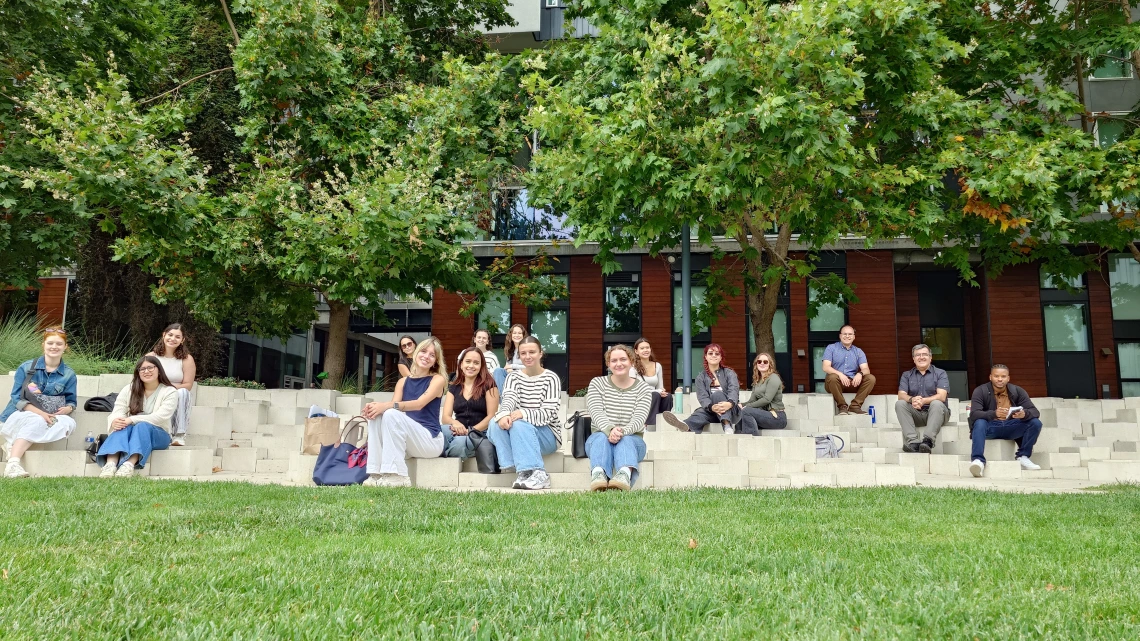
Students conducted a case study visit to Potrero 1010 a housing development by David Baker Architects, San Francisco.
Students learned about urban spaces, density, materials, and urban conditions surrounding a complex site.
Students in the University of Arizona College of Architecture, Planning and Landscape Architecture’s ARC 410F/510F Advanced Studio Urban Design, part of the Senseable Environments track, recently traveled to Oakland, California, to engage directly with the complex urban issues shaping the Bay Area.
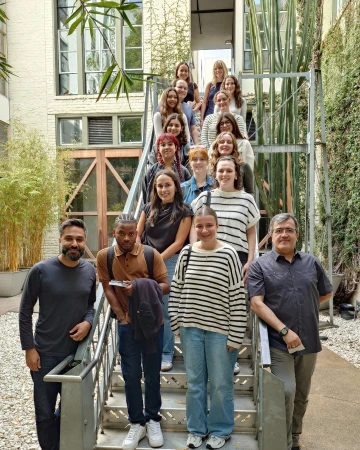
Students visited David Baker Architects in San Francisco.
Front left, principal Pedram Farashbandi from David Baker Architects, San Francisco
Front right, Eduardo Guerrero, Senior Lecturer of Architecture & Urban Design
Catie Schneider, Anselmo Vinhas, Grace Golden, Norah Evans, Abigail Martinez, Ainslie Mellinger, Maritza Noriega, Anthony Rascon, Charlotte Zeitlin, Paige Daniels, Paola Salas, Morgan Greseth, Kendall Lines, Stephanie Musto, Tiffany Sanchez
Donovan Chester / not pictured
Guided by Eduardo Guerrero, Senior Lecturer in Architecture and Urban Design, the studio examines how research and design intersect to address contemporary urban challenges—from housing instability and widening inequality to climate change and sea level rise. The course encourages students to connect rigorous inquiry with innovative design solutions through a series of milestones culminating in urban visions, goals, and design guidelines represented through models and plan proposals.
For the 16 students enrolled this semester, visiting Oakland—the third-largest city in the Bay Area and a major West Coast port—brought the city’s challenges and opportunities vividly to life. In recent decades, Oakland has experienced rapid gentrification, disinvestment, and growing social inequities. Like other coastal cities, it also faces mounting environmental pressures.
During the field trip, students visited neighborhoods across Oakland and San Francisco to observe how social, economic, and environmental factors are layered into the built environment. They met with local leaders, toured key sites, and visited leading design firms including David Baker Architects, Skidmore, Owings & Merrill (SOM), and CMG Landscape Architecture to gain professional insight into how architects and planners engage with pressing urban issues.
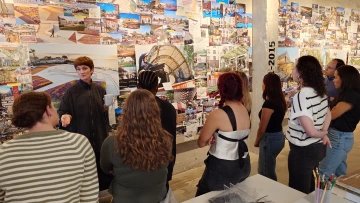
Office visit guided by Brittany Giunchigliani, at CMG Landscape Architecture, San Francisco.
“Visiting Oakland allowed me to experience the complexities of urban space in ways that physically mapping and drawing in a studio could not fully convey,” said Stephanie Musto, a fifth-year Bachelor of Architecture (B.Arch) student. “Successful urban design requires empathy and collaboration. Seeing firsthand how architecture firms address housing inequality and climate resilience helped me realize that design is deeper than just creating—it’s about listening and responding.”
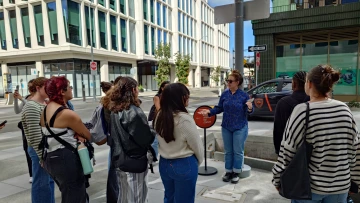
Case study visit to Mission Rock, a waterfront neighborhood.
Guided by Lauren Bergenholtz, CMG Landscape Architecture, San Francisco
For Maritza Noriega, a fifth-year B.Arch student, walking the streets and talking with the community revealed the realities behind the statistics.
“Only by being there were we able to see the issues that waste has on the landscape, the underuse of buildings due to high rent, and the way people facing homelessness affect the city,” she said. “The most memorable part was visiting places like Salesforce Park and the
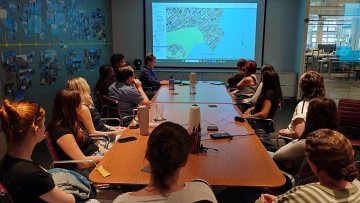
Lecture about Mission Rock, a waterfront neighborhood.
Office visit, at CMG Landscape Architecture, San Francisco
Ferry Building—examples that show how design, engineering, and history intertwine to shape urban life.”
Anselmo Vinhas, a fifth-year B.Arch student, emphasized how the trip deepened his awareness of the “sensible forces” that define a city’s atmosphere.
“Being there in person allowed me to see, feel, smell, and listen to the city,” he said. “Understanding a city is not only about form and data but about how it feels to be there. That awareness can only come from being physically present.”
Through their time in the Bay Area, students gained more than technical knowledge—they developed a deeper sensitivity to place and people.
“As architecture students, we’ve focused mainly on the desert environment,” said Vinhas. “This trip reminded me that architecture extends far beyond one region. Experiencing another city firsthand expanded my perspective on what it means to be contextually responsive and globally aware.”
For Guerrero, that realization is exactly the goal.
“Our Urban design studio is about cultivating both analytical rigor and design theory to achieve livable urban environments” he said. “Experiencing the city firsthand transforms how students think about scale, context, and impact.”
Guerrero added: “Such experiences contribute to the formation of a lasting design ethic, fostering an understanding of the built environment not just as an aggregation of buildings, but as a complex system of relationships between architecture, landscape, and planning in the public space.”
By the end of the semester, students will translate their observations and research into forward-looking proposals that reimagine Oakland’s future, creating urban visions and design frameworks that respond to real-world challenges.
“This relational perspective encourages the development of a strong sense of place and awareness of the social and spatial dynamics that shape the urban realm,” Guerrero said.
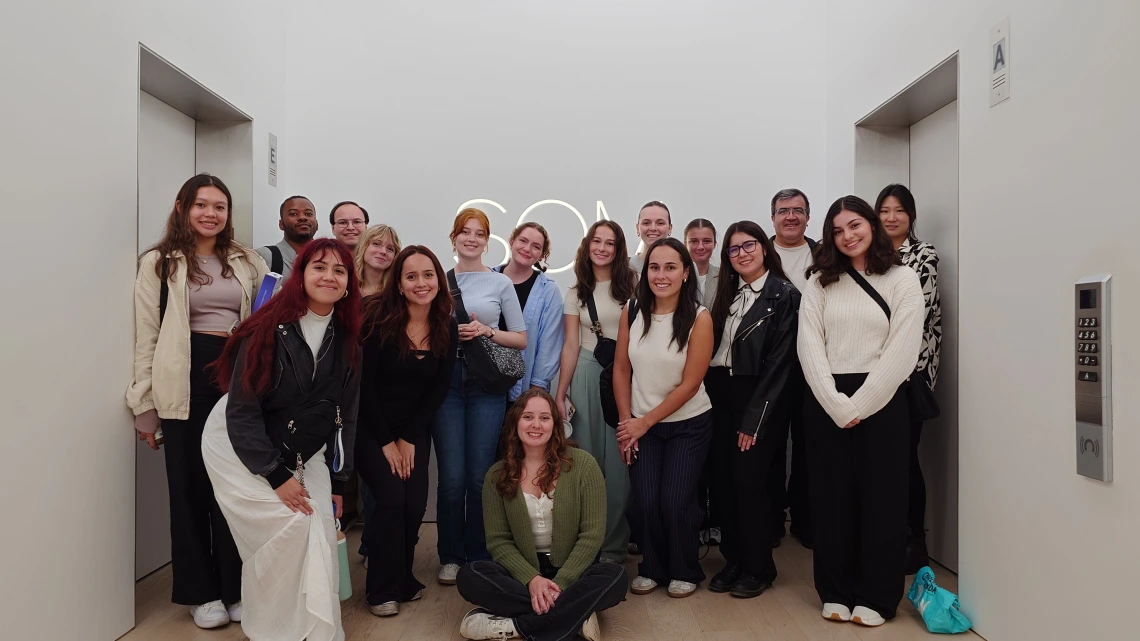
Office visit, at SOM San Francisco
Lecture by Ellen Lou, and Anne Chen.


