

Leaving a Lasting Impact: Nathan Becenti ‘25 M.Arch

“I then became the person I wished I had in undergrad. I was a mentor for the club and used club meetings as opportunities to talk about Indigenous designers and their projects. It felt like I had a mini class where I taught stuff I wish I knew earlier.”
Nathan Becenti is the founding president of CAPLA’s chapter of the Indigenous Society of Architecture, Planning & Design (ISAPD) as a student and has loved seeing its growth. He now works as an Associate at Line and Space in Tucson and took a moment to reflect on his time at CAPLA.
1. What inspired you to become a founding chapter president of ISAPD at CAPLA?
I wouldn’t say it was an inspiration. It was more of my own passion and will that pushed me to establish the chapter. While I was in undergrad, I started to understand what Indigenous design was and I spent time researching more and more into the topic with each studio project. Back at the University of Nevada Las Vegas, I was the only Native in the program and had no one to ask questions to.
When I got to CAPLA for my Master of Architecture, I learned about ISAPD from Professor Laura Carr. At UNLV, I was the Vice President of the American Institute of Architecture Students (AIAS) chapter, so I had a general idea of what I needed to do in order to establish the chapter. I signed up for A LOT of tabling opportunities around campus and events for the Native American Student Affairs (NASA).
After a couple of months, I had enough members to register the organization with the university and officially establish the ISAPD chapter at CAPLA. The club was recognized by the national ISAPD in November 2024.
I then became the person I wished I had in undergrad. I was a mentor for the club and used club meetings as opportunities to talk about Indigenous designers and their projects. It felt like I had a mini class where I taught stuff I wish I knew earlier.
2. Looking back, what are you most proud of when it comes to the chapter's growth and impact on students since its founding?
Personally, what I am most proud of most is seeing the chapter grow without me. I was glad to set examples, but what’s better is seeing them grow from that.
What is mind blowing is how rapidly the club grew. In just two years, the club had a Sustainable by Design Symposium with phenomenal speakers. I am very proud of them and I never would've imagined seeing the club back home marching in the Navajo Nation Parade. I have attended events since I graduated, such as the Sustainable by Design Symposium and even toured them around the Line and Space office. Events like these give students that much needed exposure to the profession.
3. How has the chapter helped create opportunities for Indigenous students interest in architecture, planning and design?
The main goal of ISAPD is to spread awareness of Indigenous design. The club has events where Indigenous professionals come in and sit down for a conversation. In the first year, we had an event called “Frybread with an Architect.” We had Alumni Dyron Murphy, founder of Dyron Murphy Architects, come in and talk about his projects, design approach and what it was like to own his own firm. We also had Wanda Dalla Costa, founder TAWAW Architecture Collective join us during one of our meetings and present her work and theory.
Outside of the college, we have presented back on the Navajo Reservation. This past month, Ganado High School invited board members and I to present our work and the club to the Architectural Drafting Program. This allows high school students back home to see what it is like in school and in the profession.
4. How did that experience enhance your education and prepare you for your career? How did it change your perspective on the field?
That day to me was a dream. The people on that panel were leaders in the field and for them to all be in the same place at one time was mind blowing. I just wish that the auditorium was packed with more students and local designers.
During the day, I had the opportunity to do desk crits with Johnpaul Jones of Jones and Jones. I have read and cited his work for so many years while in school. He was one of the first guys doing contemporary Indigenous design. They say we all stand on the shoulders of giants, and he was one of those giants. He spoke about integration of nature and storytelling in his work. Each designer had their own approach.
That day, we had Dalla Costa speak about her approach and her process of community engagement. Jones spoke of lessons he found in his projects. Dr. Ted Jojolla spoke about planning from an Indigenous perspective. Each designer is different in their own unique way.
5. Why do you think events like the Sustainable by Design Symposium are important for students and professionals in the field?
Events like the Sustainable by Design Symposium are so vital to the design community, not just because it provides exposure to the topic, but it also becomes a gathering for Indigenous designers. I have met many native designers at events like this. There aren't many of us, so it’s nice to see each other in one room. It builds community. For students, it is an opportunity to be exposed to leaders in the field. It's also an opportunity for the school to meet these designers, which has potential for future events.
6. Since graduating from CAPLA, what has your career journey looked like, and what drew you to your current role at Line and Space?
I actually interned at Line and Space the whole time while I was in grad school. Prior to that, I was a designer back in Vegas at another firm for about two years helping with projects on the Las Vegas strip. I even got to work with the Las Vegas Paiute on their Health and Wellness Center which finished construction last year. My 4th year professor, and now mentor, Eric Strain, took our studio all around the Southwest and on one of the trips we came to Tucson.
One of the firms we visited was Line and Space and that is where I met my future bosses. Coming from Vegas, I rarely experienced architecture that worked with the surrounding landscape. When we toured the Line and Space office, I noticed that all of their work really strived to connect with the outdoors. Everything was carefully tailored to the site and took into account every user that would be in the space. I realized there was a level of design I wasn’t exposed to just yet. I was so encapsulated by their work. At the end I told them I was planning on going to U of A and was told to send in my portfolio and “we’ll see what happens.”
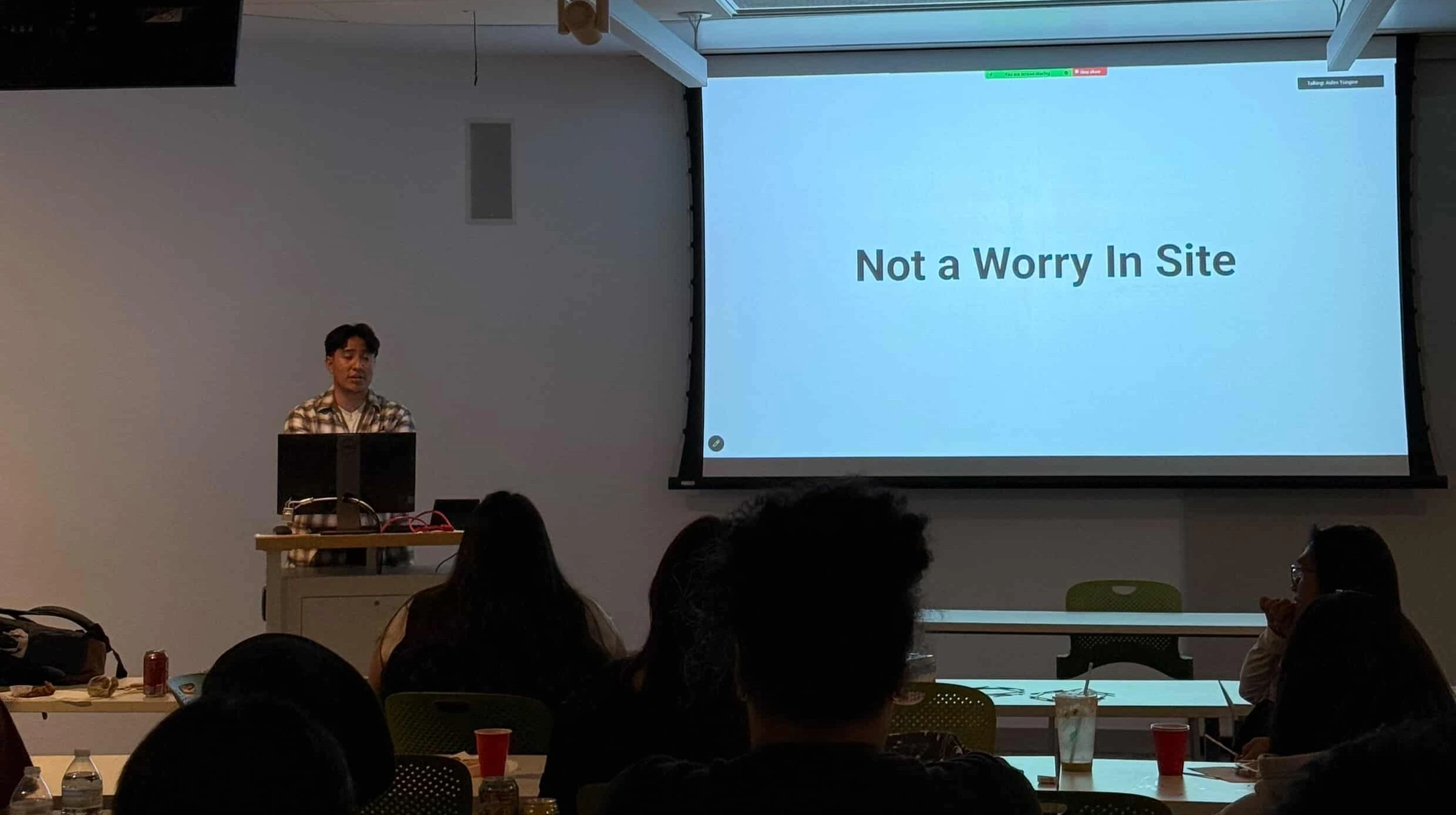
Nathan Becenti presenting his solo exhibition “Not a worry in site” at the AISES chapter on campus, sharing insights on architecture, cultural storytelling, and the intersection of design with Indigenous knowledge.
Fast forward two years later, after graduating with my Master of Architecture, I became an Associate at Line and Space. Outside of the office, I had the opportunity to be on the AIA Associates Gathering Committee. Our past gathering was at Taliesin West and I made the suggestion to have Chris Cornillius of Studio Indigenous as a speaker. This resulted in a gathering of Indigenous designers at the event. I have also been a guest presenter for the American Indian Science and Engineering Society (AISES) chapter on campus.
7. Can you tell us about a recent project or accomplishment at Line and Space that you're particularly excited about?
Since I started at Line and Space, I have heard the word “REMLA” over and over again. “REMLA” stands for the Richard Elias Mission Library Addition. I was very involved in the construction administration process. When I started, it was mostly just the CMU walls of the addition going up.
I have been lucky to be around great mentors and learn a great deal over the past couple of years. It’s fulfilling to see something I helped with go up. I grew up on a ranch constantly building or doing maintenance on something, and I enjoy the construction process. I started to understand that the construction of a building is where craftsmen come together to make something beautiful. Now, I tend to see buildings as a form of sculptures, where each trade is an artist that gets to add to it.This library recently finished up construction and I am looking forward to the grand opening.
Recently, I have been put on the Joel D. Valdez Downtown Library Relocation here in Tucson. It has been great and pretty fun to be involved in a project of this scale this early.
8. How has your M.Arch degree from CAPLA prepared you for the challenges and opportunities you've encountered in professional practice?
My time at CAPLA taught me how to think more critically about design and how to communicate ideas clearly. While technical skills are important, what I value most from my education is learning how to ask better questions. Studio culture pushed me to constantly test ideas, defend design decisions,and consider how architecture impacts the people and communities it serves. CAPLA also exposed me to a wide range of perspectives through faculty and classmates from different backgrounds. That experience helped me become more adaptable and collaborative, which are skills I use every day in professional practice.
The program also gave me the freedom to explore Indigenous design in Laura Carr’s studio specifically more into my own Navajo Traditions. That foundation continues to influence the way I approach projects today and has opened opportunities beyond traditional practice, including research, teaching and exhibiting my work as an artist.
9. In what ways do your Indigenous identity and experiences continue to influence your approach to architecture and design?
Since graduating, I felt like I never really had the opportunity to research what I wanted to for my thesis. I wanted to study a topic that really fascinated ME. I had years of research in a topic I never got to explore independently, so I started to convey my research in the form of fine art. I have been a featured and invited artist in exhibitions here in Tucson and Vegas.

Nathan Becenti’s “Not a worry in site” exhibition at Bahti Indian Arts blends architecture and art, using sand from the Chuska Mountains to tell stories of land, memory, and cultural heritage. His work honors the Navajo Nation and carries forward Indigenous knowledge through storytelling and design.
One day, I approached a local gallery to feature two of my works. I presented my collection of work and then they decided right then and there to give me the whole room. Next thing I knew, I had three months to curate my own solo exhibition.
In this exhibition, I wanted to understand specifically more about my own tribe's traditional structures. I was finally out of school and I wanted to begin my process of understanding why I design the way I do. I wanted to break my mindset down to the bare bones and rebuild with a new understanding of myself as a designer. This process started with the Navajo Hogan, not just the form, but understanding the traditional stories, construction, detailing and materials.
What came out of it was an exhibition composed of eight pieces and an installation, all centered around Navajo architecture and stories about it from my childhood. Two of my pieces are still up, and can be found at Bahti Indian Arts in the Barrio Viejo Neighborhood.
This is an ongoing research topic for me, which will likely entertain me for the rest of my career. I am planning on doing another exhibition next year with what more I find out. Every time I travel back home to my family’s ranch on the Navajo Nation, I use it as another opportunity to learn more and more. One day, I wish to go back and drive the backroads and document the traditional structures I see.


10. What advice would you give current CAPLA students who hope to make an impact in their communities?
I would say to be involved as early as possible and that you don’t need to wait for permission to start something you really care about. I was taught from a very young age that “no one is going to help you but you.” Many of the opportunities that shaped my career came from simply showing up, introducing myself and being willing to put in the work. One might not notice, but people are paying attention and it’s not too hard to stand out.
I would also encourage students to stay connected to the communities they come from. In school, I would attend various Indigenous clubs around campus and talk to EVERYONE. This led to collaborative opportunities around campus for ISAPD as well as an opportunity to learn about other Indigenous communities.
Some of the most meaningful work happens when you understand the people you are designing for. Listen more than you speak, ask questions and spend time learning from community members. Good design is not about having all the answers; it’s about understanding what questions need to be asked.


